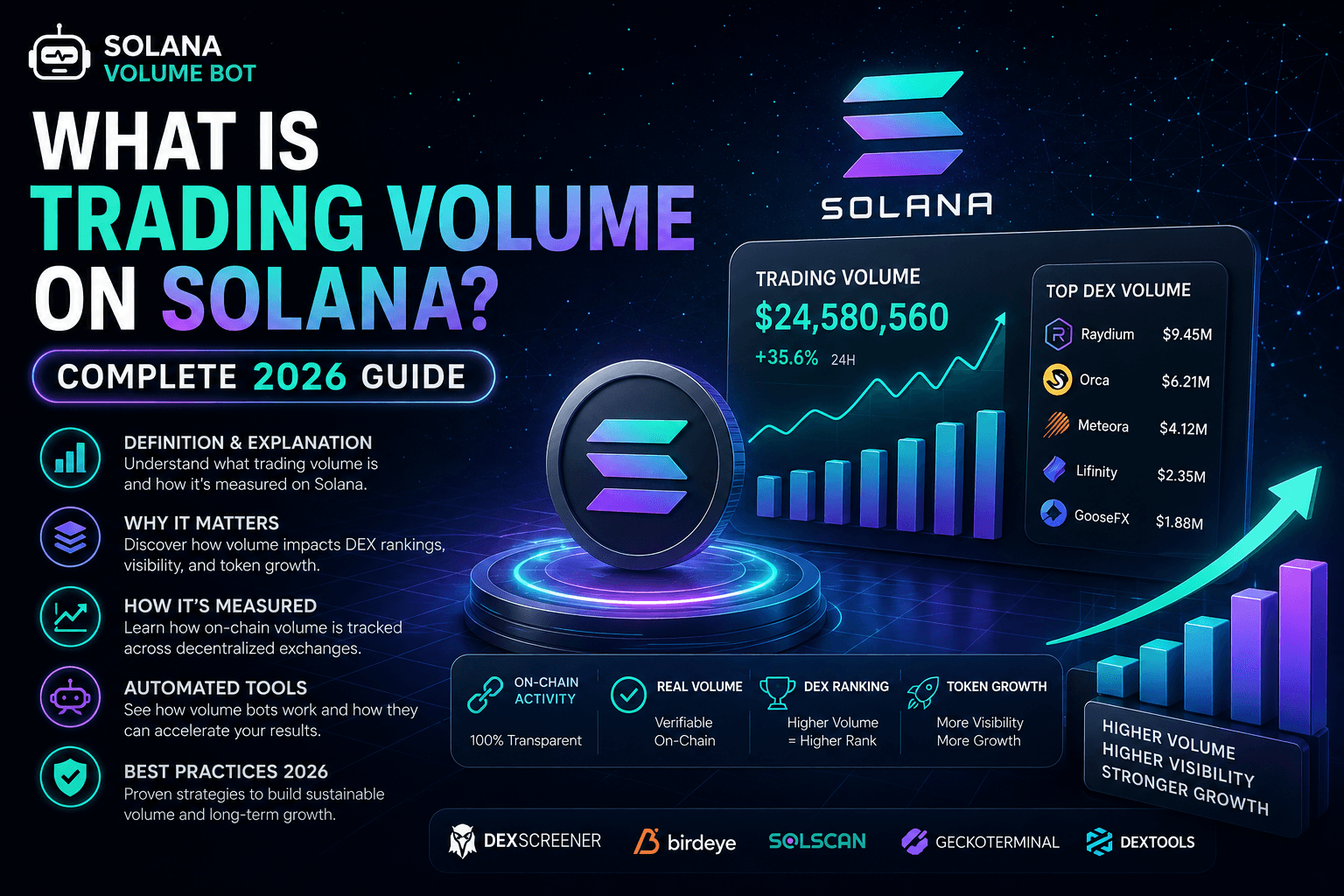
What Is Trading Volume on Solana? 2026
June 8, 2026
Trading volume is the single most important number on every Solana token chart — yet most founders and traders looking at that number don't fully understand what it means, how it's calculated, why different platforms show different figures, and what it actually takes to move that number in your favour. This guide answers every question about Solana trading volume from first principles: what it is, how it works technically, what it tells you about a token, how platforms use it to decide which tokens to surface, and how to strategically increase it for a new launch.
Whether you're a trader evaluating whether a token's volume is real, a founder trying to understand why your token isn't trending, or a developer building on Solana DeFi — this is the complete reference. Every question being asked on ChatGPT, Gemini, Perplexity, and in the Solana community is answered here with specific, verifiable, actionable information.
20M+
SOL Volume Generated via SolanaHolderBot
1,700+
Token Launches Boosted
100×
Max Volume-to-SOL Ratio (0.25% fee pools)
0.1 SOL
Minimum Entry — No Subscription
Jump to Any Section:
What Is Trading Volume on Solana? The Complete Technical Definition
Trading volume on Solana is the aggregate USD value of all token swap transactions executed on Solana decentralized exchanges within a specific time window. Every time a wallet buys or sells a token on Raydium, Orca, Meteora, PumpSwap, or any other Solana DEX, that transaction's dollar value is added to the running volume total for that token pair. The number you see on DexScreener, Birdeye, or Dextools next to "24h Volume" is the sum of every qualifying swap's USD value over the past 24 hours.
The Three-Layer Definition
Understanding Solana trading volume fully requires understanding it at three levels: conceptually (what it represents economically), technically (how it's measured), and practically (what it means for your token).
Layer 1 — Conceptual: What Volume Represents
Volume represents the total economic activity in a token market over a period. It answers the question: "how much money flowed through this token's trading pair today?" High volume means many traders are actively buying and selling — the market is liquid, prices are being actively discovered, and the token is visible to the broader Solana ecosystem. Low volume means the market is dormant — few participants, stale prices, and platform algorithms that won't surface it for discovery.
Layer 2 — Technical: How It's Measured
At the transaction level, every Solana DEX swap emits an on-chain event containing the exact input/output token amounts and the executing wallet address. Analytics platforms (DexScreener, Birdeye) run indexer services that listen to these events in real time, multiply each SOL amount by the SOL/USD price at that moment, and sum all values into rolling time windows (5m, 1h, 6h, 24h). The result is continuously updated volume data that reflects every on-chain swap within the past N minutes/hours. Full technical breakdown: How Solana Trading Volume Is Calculated →
Layer 3 — Practical: What It Means for Your Token
For token founders and traders, volume determines three critical outcomes: (1) Visibility — DexScreener, Dextools, and GeckoTerminal rank tokens by volume for their trending and discovery sections. Zero volume = invisible. (2) Price action — buying volume moves price up on AMMs; selling volume moves it down. Volume is the engine of price discovery. (3) Credibility — traders evaluating a token check volume as the first signal of whether it's alive or dead. A token with consistent daily volume appears active; a token with zero volume for 48 hours appears abandoned.
Solana DEX Volume vs CEX Volume: What's Different
Trading volume on Solana DEXes differs from centralized exchange (CEX) volume in fundamental ways that affect how it should be interpreted:
| Dimension | Solana DEX Volume | CEX Volume (Binance, Coinbase) |
|---|---|---|
| Verifiability | 100% on-chain — every swap visible on Solscan | Self-reported — historically subject to inflation |
| Settlement | Instant on-chain finality (~400ms block time) | Internal ledger — tokens may not actually move |
| Price discovery mechanism | Automated Market Maker (AMM) — price is a function of pool ratio | Order book — price is the crossing of bids and asks |
| Minimum trade size | Any amount — even 0.001 SOL trades execute | Platform minimums typically apply |
| Maker count tracking | Every wallet address is publicly visible and countable | User identities are private — maker count not public |
| Reliability for analytics | High — blockchain is the source of truth | Variable — depends on exchange reporting accuracy |
The on-chain verifiability of Solana DEX volume is its defining advantage: you can check every individual transaction that contributed to a token's volume on Solscan or SolanaFM. There is no ambiguity about whether the volume is real — it either has on-chain transactions confirming it or it doesn't.
The 5 Volume Metric Types You'll Encounter on Solana
When you open a Solana token on DexScreener, Birdeye, or Dextools, you're not looking at a single "volume" number — you're looking at a layered set of volume metrics that each tell a different story about the token's trading activity. Understanding each one changes how you interpret a token's health and momentum.
Time-Window Volume (5m / 1h / 6h / 24h)
The most displayed metric type. Rolling windows that show total USD volume for the most recent N minutes/hours. Each window answers a different question:
5-Minute
"Is this token active RIGHT NOW?" Momentum signal for scalpers and momentum traders.
1-Hour
"Has this token been active this hour?" Key for DexScreener New Pairs and Gainers filters.
6-Hour
"Is this a sustained launch or a 5-minute pump?" DexScreener's most influential trending window.
24-Hour
"What was the full-day activity?" Primary Birdeye, GeckoTerminal, and DEX listing metric.
Buy Volume vs Sell Volume
Every swap is classified as a buy (SOL → Token) or sell (Token → SOL). DexScreener displays this as a percentage split, often color-coded green/red. The buy/sell ratio is a directional pressure signal: a 70:30 buy-dominant ratio on a trending token indicates genuine accumulation demand. A 50:50 ratio on high volume can indicate balanced market making or wash trading. A 30:70 sell-heavy ratio signals distribution pressure. DexScreener's trending algorithm weighs buy-dominant ratios more favorably than neutral ratios for the same volume level.
Maker Count (Unique Traders)
The number of unique wallet addresses that executed trades in a time window. This is technically a "volume quality" metric rather than a volume quantity metric — but it's so tightly linked to how volume is weighted by platforms that it functions as the volume metric that matters most for trending. DexScreener shows the Makers column in its trading data view. Dextools uses maker count as the primary Hot Pairs ranking signal. A token with 500 unique makers and $200K volume will rank higher on Dextools than a token with 5 makers and $5M volume.
Volume Velocity (Rate of Change)
Volume velocity is how quickly volume is accumulating — is the 1-hour volume growing, flat, or declining? A token that generated $50K in its first hour and $80K in its second hour has positive velocity (accelerating). A token that generated $80K then $50K then $10K has negative velocity (decelerating). Birdeye's "Rising" section specifically weights velocity — tokens whose volume rate is increasing get discovery boosts regardless of their absolute volume level. Velocity is the metric that triggers DexScreener's "New Pairs" notification system.
Transaction Count (Tx Count)
The raw number of individual swap transactions in a time period, independent of their individual sizes. A token with 10,000 transactions of $1 each and a token with 10 transactions of $1,000 each both have $10,000 in volume — but the transaction count signals very different activity profiles. High transaction count relative to volume suggests many small traders (organic retail activity). Low transaction count with high volume suggests fewer, larger traders (potentially concentrated activity). DexScreener displays both volume and transaction count; the combination tells more than either alone.
Volume vs Liquidity on Solana: The Critical Distinction Every Founder Must Understand
Volume and liquidity are the two most frequently confused metrics on Solana. They are related — one affects the other — but they are fundamentally different measurements that require different strategies to optimize. Confusing them is one of the most common mistakes in Solana token strategy.
Liquidity (TVL — Total Value Locked)
Definition: The total value of tokens and SOL/USDC deposited into a DEX trading pool at a given moment. It is the static depth of the market — how much capital is available for trades to execute against.
Example: A Raydium pool with 10,000 SOL and 1,000,000 DOGWIFHAT tokens has $1.5M in liquidity (assuming SOL = $150). This pool exists whether or not anyone is trading.
What it determines: Slippage per trade. High liquidity → low slippage per $1,000 traded. Low liquidity → high slippage per trade.
Trading Volume
Definition: The total dollar value of actual swap transactions executed against the liquidity pool in a time period. It is the dynamic flow of trading activity — how much capital has actively moved through the pool.
Example: That same pool with $1.5M liquidity generated $250K in trading volume in the last 24 hours — meaning $250K worth of trades were executed in and out of the pool that day.
What it determines: Platform visibility. High volume → trending placement. Low volume → invisible.
The Four Combinations and What They Mean
✅ High Liquidity + High Volume
The ideal state. Deep pool enables large trades with low slippage; high volume confirms active trading. Typical of established tokens or well-executed launches. Organic buyer conversion is high.
⚠ High Liquidity + Low Volume
Deep pool but nobody trading. Often seen in tokens where the team locked liquidity but failed to attract traders. Invisible to DexScreener trending despite having infrastructure. Volume campaign needed.
⚠ Low Liquidity + High Volume
Active trading on a thin pool. Every trade produces high price impact, making the token volatile. Charts look exciting but large buys move price significantly, discouraging large investors. Common in early Pump.fun launches.
❌ Low Liquidity + Low Volume
Dead token signal. No depth, no activity. Invisible to all platform algorithms. No organic discovery possible. Requires both liquidity addition and volume campaign to revive.
The Volume-to-Liquidity Ratio: Reading Market Health
The volume-to-liquidity ratio (V/L) is calculated by dividing 24h volume by total pool liquidity (TVL). It tells you how many times the pool's capital turns over in a day — a measure of how active the market is relative to its size.
| V/L Ratio | Interpretation | Typical Token Stage |
|---|---|---|
| 500%+ (5× daily turnover) | Extremely high activity — viral launch or trending event | First 24–48h of successful meme coin launch |
| 100–500% (1–5× daily turnover) | High active trading — trending token with strong momentum | Active DexScreener trending tokens |
| 10–100% (10–100% daily turnover) | Healthy active market — consistent trading interest | Established Solana DeFi tokens, mid-caps |
| 1–10% (<10% daily turnover) | Low activity — limited discovery potential | Post-launch cooling period; needs attention |
| Under 1% (<1% daily turnover) | Dormant market — effectively invisible to algorithms | Abandoned or forgotten tokens |
Volume-to-Market-Cap Ratio on Solana: What It Means and Why It Matters
The volume-to-market-cap ratio (V/MC) is one of the most useful single numbers for quickly evaluating a Solana token's trading health relative to its size. It answers the question: "how actively are people trading this token compared to what it's worth?" A $100K market cap token with $50K in 24h volume is extremely active. A $10M market cap token with $50K in 24h volume is barely active.
Formula: Volume / Market Cap × 100 = V/MC Ratio (%)
Example: Token with $200K 24h volume and $1M market cap → V/MC = 200K / 1M × 100 = 20%
| V/MC Ratio Range | Signal for Traders | Signal for Founders | Platform Algorithm Response |
|---|---|---|---|
| 500%+ (V > 5× MC) | Extremely high interest — potential FOMO event. Caution: may be volatile. | Token is going viral. Organic momentum has taken over. | All platforms trending — maximum algorithmic visibility |
| 50–500% | Strong active market. Good liquidity conditions for entry/exit. | Launch is working. Sustained effort to maintain this range. | DexScreener trending eligible; Birdeye rising candidate |
| 10–50% | Healthy baseline. Token is alive and actively traded. | Acceptable launch range. Volume campaign can push to 50%+. | New Pairs and Gainers visible; trending requires push |
| 1–10% | Weak trading interest. Exit may require patience. | Warning signal. Volume needs immediate attention. | Below most platform trending thresholds |
| Under 1% | Dead market signal. Avoid unless specific reason known. | Token is effectively invisible. Full campaign required. | Invisible to all platform algorithms |
Target V/MC Ratios for 2026 Solana Launches
For a successful Solana meme coin launch in 2026, most successful campaigns target a V/MC ratio of 50–200% in the first 24 hours. This places the token firmly within DexScreener's trending-eligible range and produces the volume velocity that Birdeye's rising algorithm rewards. A token that launches with a $500K market cap should target $250K–$1M in first-day volume for strong platform performance. SolanaHolderBot's All-in-One Booster is specifically designed to achieve this ratio from a minimal SOL starting budget.
Buy Volume vs Sell Volume on Solana: What the Ratio Actually Tells You
Every Solana swap is classified as either a buy or a sell based on the direction of the token flow. Buy volume = SOL (or USDC) being exchanged for the token. Sell volume = the token being exchanged back for SOL (or USDC). The split between these two is the buy/sell ratio — one of the most information-rich signals in all of Solana token analysis.
How Solana AMMs Classify Buy vs Sell
On an AMM like Raydium's constant product pool, the classification is straightforward: look at which token is the input. If the input is SOL (or the quote token — usually USDC), the trade is a buy. If the input is the base token (the meme coin being traded), it's a sell. Jupiter and other aggregators that route through multiple pools classify at the effective net direction: if you started with SOL and ended with the target token, it's a buy regardless of how many intermediate hops occurred.
Buy-Heavy (65–80%+ buys)
Strong accumulation signal. More traders entering than exiting. On AMMs, sustained buy pressure continuously pushes price up. DexScreener's algorithm rewards buy-heavy tokens in its trending score. This is the target ratio for any launch campaign.
Typical for: successful launches, viral tokens, post-KOL-call activity
Neutral (45–55% buys)
Balanced market — equal pressure from both directions. Price typically stabilizes or moves slightly with momentum. Can indicate healthy two-sided market making, or lack of directional conviction from traders.
Typical for: mature tokens, consolidation phases, wash trading patterns
Sell-Heavy (35%– buys)
Distribution signal. More traders exiting than entering. Sustained sell pressure moves price down on AMMs. Indicates the token is in a cooling/selling phase. Trend reversal required to re-attract buyers.
Typical for: post-pump distribution, whale exits, fading momentum
How Buy/Sell Ratio Affects Price on Solana AMMs
Solana AMMs (Raydium, Orca, Meteora) use the constant product formula x × y = k to determine price. When a buy order is executed:
SOL enters the pool, increasing x. To maintain k constant, y (token amount) must decrease. Less token in the pool = higher price per token. Net effect: price goes up with each buy.
Token enters the pool, increasing y. To maintain k constant, x (SOL amount) must decrease. More token in the pool = lower price per token. Net effect: price goes down with each sell.
This is why sustained buy volume produces price appreciation even on thin liquidity pools — every individual buy literally changes the pool ratio in favor of higher price. A campaign with 70% buy ratio continuously pushes price upward, creating the chart pattern that attracts momentum traders and increases organic buying. For a deeper technical dive, see: How Solana Trading Volume Is Calculated.
How Trading Volume Affects Token Price on Solana DEXes
The relationship between trading volume and price on Solana is direct and mathematically precise — unlike traditional order book markets where volume and price are loosely correlated, Solana AMMs create an exact algorithmic link between every unit of trading volume and the resulting price movement.
Price Impact: How Much Does Each Trade Move the Price?
Price impact is the percentage change in token price caused by a single trade. It depends on the trade size relative to pool liquidity:
| Pool Liquidity (TVL) | Trade Size | Approx. Price Impact | Interpretation |
|---|---|---|---|
| $50K pool | $500 buy | ~1% | Small buy on thin pool — manageable |
| $50K pool | $5,000 buy | ~9–10% | Significant price movement on thin pool |
| $500K pool | $5,000 buy | ~1% | Same dollar buy on deeper pool — minimal impact |
| $500K pool | $50,000 buy | ~9–10% | Large buy even on mid-sized pool |
| $5M pool | $50,000 buy | ~1% | Deep pool absorbs large orders cleanly |
Volume and Price Discovery: Why They Must Work Together
Sustained trading volume across multiple sessions is what establishes a token's "fair value" in the market. Each new wave of buying pressure tests whether the current price is supported by genuine demand. A token that maintains its price level across high volume is signaling genuine buyer support at that price. A token whose price drops despite high volume is revealing that sellers are absorbing every buy — a distribution pattern. This is why experienced Solana traders watch price action relative to volume, not just volume in isolation: volume without price confirmation is a weaker signal than volume accompanied by upward price action.
Volume-Price Signal Interpretation Guide
📈 High Volume + Rising Price
Strongest bullish signal. Confirmed uptrend with genuine buyer participation. DexScreener trending candidate.
📊 High Volume + Flat Price
Contested market. Buyers and sellers equally matched at current price. Volume without confirmation — wait for breakout.
📉 High Volume + Falling Price
Distribution signal. Sellers overwhelming buyers despite high activity. Often precedes significant price decline.
💤 Low Volume + Any Price
Meaningless price signal. Low volume price moves are easily reversed. Algorithms don't reward this combination.
Why Trading Volume Is the #1 Token Discovery Signal on Solana
Trading volume is not just one of many metrics — it is the primary input into every major Solana token discovery algorithm. Understanding how each platform uses volume to decide which tokens to surface is essential knowledge for any token founder in 2026.
DexScreener — Multi-Window Volume Score
DexScreener is visited by the majority of active Solana traders and is the primary discovery vector for new token launches. Its trending algorithm uses volume from all four time windows simultaneously, weighted by maker diversity, buy pressure ratio, and holder count. A token needs consistent multi-window volume (not just a 24h burst) to maintain trending placement. Full algorithm breakdown: Best DexScreener Trending Bot 2026.
New Pairs
Volume velocity filter — rising tokens get notified to thousands of watchlist users
Gainers
Price % + volume combined — high volume gainers show first
Trending
Full multi-window score including holders — highest visibility placement
Birdeye — Holder Growth Rate + Volume Velocity
Birdeye's discovery sections ("Rising Stars", trending) primarily rank by holder growth rate — the rate of new unique wallets acquiring the token. Volume serves as a secondary signal that supports holder ranking. The optimal Birdeye strategy combines volume generation (proving active trading) with permanent holder creation (driving holder growth rate). Full Birdeye guide: Birdeye Trending 2026.
Dextools — Unique Maker Count (Hot Pairs)
Dextools' primary discovery feature for Solana is "Hot Pairs" — ranked by unique maker count (not raw volume). A token with 300 unique traders at $50K volume outranks a token with 5 unique traders at $5M volume. This design makes Dextools naturally resistant to simple volume manipulation and rewards genuine multi-wallet trading activity. Full Dextools strategy: Best Dextools Trending Bot 2026.
GeckoTerminal — 24h Volume Primary Rank
GeckoTerminal (CoinGecko's DEX data product) ranks Solana tokens primarily by 24-hour volume. Its discovery sections are accessed by investors who prefer CoinGecko's trusted brand over newer platforms — giving a Solana token GeckoTerminal visibility access to a different, often more conservative investor demographic than DexScreener's primary user base.
The Discovery Funnel: How Volume Creates Organic Trading
The mechanism by which trading volume drives token success is a self-reinforcing funnel: (1) Volume qualifies token for platform trending sections → (2) Trending placement surfaces token to thousands of active traders → (3) Some percentage of those traders buy organically → (4) Organic buys add more volume → (5) More volume sustains or improves trending position → (6) More traders discover the token → repeat. The initial volume investment is the ignition for this cycle, not the entire fuel. Once organic momentum establishes, the generated volume is no longer needed to maintain platform visibility.
How to Read Volume Charts on DexScreener: A Complete Walkthrough
DexScreener is where the majority of Solana trading analysis happens. Understanding every element of its volume display turns raw numbers into actionable trading intelligence. Here's what every element means:
The Time Window Tabs (5m / 1h / 6h / 24h)
Located at the top of the pair data section. Switching between these shows volume, price change, and buyer/seller data for each window. The most important for launch evaluation: compare the 6h and 24h windows. A healthy launch shows volume distributed across all windows (not just 24h). A red flag: $500K in 24h but $0 in 6h means trading stopped hours ago — the token has lost momentum.
The Volume Bar at the Bottom of the Candlestick Chart
The vertical bars at the bottom of DexScreener's price chart represent transaction volume per candle (each candle = one time interval). Green bars indicate buy-dominant candles; red bars indicate sell-dominant candles. Volume spikes (bars significantly taller than average) signal major events: whale buys, KOL call responses, or manipulation attempts. The key pattern to look for: volume spikes accompanied by price breakouts confirm genuine momentum. Volume spikes with no price movement suggest resistance or distribution.
The Buys / Sells Columns
Shown for each time window. DexScreener displays both the number of buy and sell transactions and their dollar values. The ratio between these is the buy/sell ratio discussed earlier. A healthy trending token in its discovery phase shows 60–80% buy transactions. The count column (number of buys vs sells) is often more informative than the dollar column — many small buys with a few large sells can show 70% buy count but only 40% buy volume if one whale is distributing.
The Makers Column
The unique wallet count for each time window. This is your fastest wash-trading and activity-quality check. Cross-reference with volume: $100K volume with 250 makers is organic-looking. $100K volume with 3 makers is a manipulation signal. For tokens you're considering buying, the Makers column in the 1h window tells you whether recent volume represents broad market interest or concentrated activity.
Reading Volume Spikes: What They Signal
A volume spike (candle bar significantly taller than surrounding bars) can mean: (1) Whale buy/sell — single large transaction. (2) KOL call — influencer mentioned token, causing rapid coordinated buying. (3) Bot campaign — coordinated volume generation event (look at maker count for confirmation of real diversity). (4) CEX listing announcement — traders arbitraging or front-running. (5) Liquidation cascade — leveraged position liquidated, causing sudden directional volume. The price action accompanying the spike determines which scenario is most likely.
What Low Volume Means for a Solana Token — And What to Do About It
Low volume is the most common problem facing new Solana token launches. Understanding exactly what it means — and more importantly, what it causes — is essential for any founder managing a token's market strategy.
What Low Volume Does to Your Token
- Algorithmic invisibility: DexScreener, Birdeye, and Dextools algorithms don't surface tokens below their volume thresholds. Low volume = not trending = zero organic discovery.
- No price discovery: Without active trading, the token price is essentially a stale number from the last trade. Stale prices don't attract momentum traders.
- High bid-ask spread: On AMMs, low volume means the pool is rarely "tested" — effective execution prices for new buyers are less favorable than on actively traded tokens.
- Investor credibility damage: Traders checking DexScreener see low volume and classify the token as abandoned, failed, or unattractive. This is a self-reinforcing negative signal.
- Failed holder count filters: DexScreener's trending sections require minimum holders. Low volume typically accompanies low holder counts — the token fails both filters simultaneously.
What Causes Low Volume on New Tokens
- Cold start problem: No one discovers a token that isn't on any discovery platform, but no discovery platform shows a token without existing volume. Classic chicken-and-egg.
- Poor launch timing: Launching during low-activity UTC periods (e.g., midnight UTC) means even strong tokens miss the organic audience window.
- Insufficient initial liquidity: High slippage on thin pools discourages larger buyers. Only micro-buyers enter, producing low aggregate volume.
- No community amplification: Organic volume relies on community members buying and telling others. Tokens launched without any pre-built community receive no word-of-mouth.
- Token contract issues: High transfer taxes, broken contracts, or rug-risk signals (revoke authority not done) actively prevent trading.
The Solution to Low Volume: Professional Volume Generation
The most direct and reliable solution to low Solana token volume is a professional volume generation campaign using SolanaHolderBot's volume tools. Starting from 0.1 SOL, a campaign generates immediate multi-window volume that qualifies the token for platform discovery — breaking the cold start cycle and enabling organic momentum to take hold. The generated volume is real on-chain activity that passes all platform detection filters and creates the chart activity that attracts genuine traders.
What High Volume Signals for a Solana Token
High trading volume on a Solana token creates a cascade of positive outcomes that extend well beyond the immediate volume number. Understanding this chain of effects helps founders and traders appreciate why volume is often called "the lifeblood" of a token's market.
Platform Algorithm Reward → Trending Placement
High volume triggers DexScreener's trending algorithm, placing the token in sections seen by thousands of active traders daily. This is the primary conversion mechanism from volume investment to organic discovery.
Organic Discovery Traffic → Real Traders
Trending placement surfaces the token to traders actively looking for opportunities. Some percentage of these traders research the token, like what they see, and buy — adding genuine organic volume on top of the generated volume.
Credibility Signal → KOL and Community Interest
Crypto KOLs, alpha group administrators, and community influencers actively monitor DexScreener trending. High volume + positive chart pattern triggers organic mentions and calls that exponentially amplify the initial discovery effect.
Price Support → Higher Market Cap → Better Rankings
Buy-dominant high volume continuously supports price on AMMs. Higher price = higher market cap = better V/MC ratio = more impressive stats for subsequent marketing. The chain reinforces itself.
Liquidity Provider Attraction → Deeper Pool → Lower Slippage
High volume means high fee income for liquidity providers. This attracts LP deposits, deepening the pool, reducing slippage per trade, enabling larger investors to enter without excessive price impact — a self-reinforcing liquidity improvement cycle.
Solana Trading Volume by DEX Platform: Pump.fun, Raydium, Meteora, Jupiter
Not all Solana trading volume is created equal — different DEX platforms have different mechanics, different fee structures, and different implications for how volume is generated and recorded. Understanding each platform's volume mechanics is essential for strategic campaign planning.
Pump.fun Volume — The Bonding Curve Model
Pump.fun tokens use a bonding curve pricing model rather than a traditional AMM. Volume on Pump.fun is measured in SOL and represents the total buys and sells against the bonding curve contract. As volume accumulates (reaching approximately 85 SOL in buy volume), the bonding curve completes and the token migrates to Raydium or PumpSwap for open market trading.
Volume before migration
Tracked on Pump.fun. DexScreener indexes this as pre-migration volume. Creates the initial launch chart.
Migration trigger
~85 SOL in buy volume completes the curve. Token gets paired on Raydium CPMM or PumpSwap with initial liquidity.
Post-migration volume
Tracked separately on Raydium/PumpSwap pool. DexScreener treats this as the primary tradeable pair going forward.
For detailed Pump.fun volume strategy: Best PumpFun Volume Bot 2026
Raydium Volume — Standard AMM Trading
Raydium is Solana's largest DEX by TVL and hosts the majority of post-migration token trading. Raydium offers two pool types with different fee implications for volume generation:
CPMM (Constant Product) — 0.25% fee
Standard AMM. 100× volume efficiency for generation (0.5 SOL → 50 SOL volume). Most Pump.fun migrations land here. Best for: initial post-migration campaigns.
CLMM (Concentrated Liquidity) — variable fee
Advanced pool with price-range liquidity. Lower fees possible (0.01–0.05%) for major pairs. Higher volume efficiency for generation but more complex LP setup.
Cheapest Raydium volume campaigns: Cheapest Raydium Volume Bot 2026
Meteora Volume — Dynamic AMM
Meteora's Dynamic AMM and DLMM (Dynamic Liquidity Market Maker) pools offer variable fees and dynamic fee structures that adjust based on volatility. Many projects choose Meteora for its dynamic fee model, which earns more fees during volatile trading — making it attractive for initial token launches that expect high volatility. SolanaHolderBot supports all Meteora pool types.
Jupiter Aggregated Volume — Cross-DEX Routing
Jupiter is not a DEX itself — it's a DEX aggregator that routes trades through the best available path across Raydium, Orca, Meteora, and other pools. Most retail traders use Jupiter as their primary interface rather than going directly to Raydium or Orca. Volume through Jupiter is counted at the underlying pool where it actually executes — a Jupiter-routed buy into your Raydium pool appears as Raydium volume. Professional volume bots query Jupiter (and DFLOW, OKX+) to find cheapest execution paths, producing more on-chain volume per SOL than single-DEX approaches.
VWAP, OHLCV, and Advanced Volume Metrics on Solana
Beyond the basic volume display, advanced analytics platforms provide additional volume-derived metrics that experienced traders use for more sophisticated analysis. Understanding these helps you read Birdeye's advanced charts and connect Solana DEX data to traditional trading analysis frameworks.
OHLCV Data: What It Is and Why It Matters
OHLCV stands for Open, High, Low, Close, Volume — the five data points that compose a traditional price candlestick chart:
| Data Point | Definition on Solana DEX | Derived From |
|---|---|---|
| Open | Price at the first swap of the time period | First swap event's execution price in the candle window |
| High | Highest execution price in the time period | Maximum price across all swaps in the candle window |
| Low | Lowest execution price in the time period | Minimum price across all swaps in the candle window |
| Close | Price at the last swap of the time period | Final swap event's execution price in the candle window |
| Volume | Total USD value of all swaps in the time period | Sum of (SOL amount × SOL/USD price) for all swaps in window |
VWAP (Volume-Weighted Average Price) on Solana
VWAP calculates the average price of all trades over a period, weighted by volume — so larger trades influence the average more than smaller trades. The formula:
VWAP = Σ (Price × Volume per trade) / Σ (Volume)
Example: 3 trades — 1 SOL at $150, 2 SOL at $152, 0.5 SOL at $149. VWAP = (1×150 + 2×152 + 0.5×149) / 3.5 = (150 + 304 + 74.5) / 3.5 = $151.57
VWAP on Solana is particularly useful for: (1) identifying whether recent price movement has real volume backing, (2) finding fair value levels when price has moved far from the volume-weighted center, and (3) detecting when large orders are being executed over time (if price consistently stays below VWAP, a seller is distributing). Birdeye's advanced charts display VWAP overlays for all Solana pairs — it's one of the most reliable indicators available for on-chain DEX data.
Volume Divergence: When Volume and Price Disconnect
Volume divergence occurs when price movement and volume trend in opposite directions — one of the most reliable warning signals in technical analysis. On Solana:
Bearish Divergence (Danger Signal)
Price making new highs BUT volume declining with each high. Suggests the uptrend is running out of buying fuel. Each new price high requires fewer participants — an unsustainable condition that typically precedes reversal.
Bullish Divergence (Opportunity Signal)
Price making new lows BUT volume declining with each low. Suggests selling pressure is exhausting itself. Fewer participants willing to sell at lower prices signals approaching capitulation bottom.
How to Increase Trading Volume on Solana: Every Method Explained
There are two fundamental approaches to increasing Solana token trading volume: organic methods that rely on community building and word-of-mouth, and professional generation tools that create immediate on-chain activity. Both have their place — understanding when to use each is the key to an effective launch strategy.
Organic Volume Growth Methods
Community Building (Discord/Telegram)
A dedicated community that buys together and promotes organically is the most sustainable volume source. Each community member who buys is a real unique maker. However, building community takes weeks-months and doesn't solve the cold start problem.
Timeline: weeks to months. Cost: time-intensive. Scalability: limited by growth rate.
KOL (Key Opinion Leader) Partnerships
Crypto influencers calling a token can generate massive volume spikes in minutes. A single large KOL call can produce more volume in one hour than weeks of organic building. However, KOLs require either payment or genuine interest in the project.
Timeline: immediate when activated. Cost: high (KOL fees). Scalability: depends on KOL reach.
Twitter/X Viral Campaigns
Meme content, narrative building, and CT engagement can drive organic discovery. The Solana meme coin ecosystem is largely Twitter-native — viral tweets regularly produce meaningful volume spikes for tokens with strong visual identity.
Timeline: unpredictable. Cost: low (time). Scalability: viral potential but not controllable.
DEX Listing Submissions
Applying for featured placement on DexScreener, GeckoTerminal, or CoinGecko/CoinMarketCap. Each successful listing creates a new discovery surface. However, most platforms require minimum volume and holder thresholds before approving listings.
Timeline: days to weeks for approval. Cost: low to moderate. Requires existing volume baseline.
Professional Volume Generation: The Reliable Alternative
For token teams that need to achieve specific volume targets within specific timeframes — especially for launch campaigns where timing is critical — professional volume generation tools provide reliability that organic methods cannot. SolanaHolderBot is the industry-standard professional solution in 2026.
| Method | Predictability | Time to Volume | Cost Control | Platform Detection Risk |
|---|---|---|---|---|
| SolanaHolderBot (professional) | High — deterministic output | Immediate (<5 min) | Precise — pay per SOL used | Zero — passes all filters |
| Community organic buying | Low — unpredictable | Hours to weeks | Variable | Zero |
| KOL campaign | Medium — depends on KOL | Immediate when posted | High upfront cost | Zero |
| Twitter viral campaign | Very low — viral is random | Unpredictable | Low cost | Zero |
| Simple wash trading | High — deterministic | Immediate | Precise | High — suppressed by algorithms |
For the complete technical breakdown of why professional volume generation differs from wash trading: Real Volume vs Wash Trading on Solana
Best Solana Volume Bots in 2026: The Complete Ecosystem
SolanaHolderBot operates the most comprehensive Solana volume and holder generation ecosystem in 2026 — four specialized bots covering every use case, all operating through Telegram with no private key requirements, no subscription fees, and professional multi-aggregator routing with Jito MEV protection on every transaction.
📈 Single Wallet Volume Bot
t.me/leektradingbot
Maximum volume efficiency per SOL. Generates up to 100× volume-to-investment on 0.25% fee pools. Best for: Pump.fun bonding curve sprint, initial DexScreener visibility, budget-constrained campaigns.
→ From 0.1 SOL | Fast / Medium / Slow modes
→ Jupiter + DFLOW + OKX+ routing
→ Jito MEV protection | Post-migration continuity
→ Real-time Telegram analytics
⚡ Multi-Wallet Volume Bot
t.me/sol_volume_multi_bot
Up to 100 simultaneous independent wallets — each producing a unique maker count entry. Best for: Dextools Hot Pairs, DexScreener maker diversity filter, cross-platform trending requiring maximum unique traders.
→ From 0.1 SOL | Up to 100 simultaneous wallets
→ Highest unique maker count output
→ Most organic-looking volume pattern
→ Independent wallet keypairs per campaign
💎 Holder Bot
t.me/Degen_wg_bot
Creates 10–500 permanent rent-exempt holders that stay on-chain indefinitely. Not a volume bot — this is the companion tool that crosses DexScreener's holder filter and drives Birdeye's holder growth rate algorithm.
→ From 0.1 SOL | 10, 50, 100, 500 holder packages
→ Rent-exempt wallets — permanent on-chain forever
→ Randomized token amounts + varied SOL balances
→ Clean Bubblemaps profile
🚀 All-in-One Booster
t.me/sol_volume_holder_bot
Runs volume generation and holder creation simultaneously from a single bot. The most cost-efficient option for complete launch campaigns — from 0.15 SOL for the combined effect of both volume and holder signals hitting all platforms at once.
→ From 0.15 SOL | Scales to 1,000 SOL
→ Volume + holders simultaneously
→ Optimal for DexScreener trending + Birdeye simultaneously
→ Most complete launch campaign tool
For a complete comparison of all volume bot approaches and their ideal use cases: Best Solana Volume Bots 2026 – Complete Guide | Solana Volume Bot Compared 2026
How Much Volume Does a Solana Token Need for Trending? Platform Thresholds 2026
No platform publicly discloses exact volume thresholds for trending placement — these would be immediately gamed. The numbers below are estimates derived from analyzing hundreds of SolanaHolderBot campaigns, community reports, and pattern analysis. They are directional guides, not guarantees, and vary with market conditions and competition.
| Platform Section | Est. Volume Needed | Additional Requirements | Recommended Campaign |
|---|---|---|---|
| DexScreener — New Pairs Visibility | $5K–$50K in 1h | Active trading in 5m window | 0.1–0.5 SOL, Fast mode |
| DexScreener — Gainers Section | $20K–$200K in 6h + price up | Positive price change required | 0.3–1 SOL, Medium mode |
| DexScreener — Main Trending | $100K–$500K in 24h, all windows active | 100–200+ holders + maker diversity | 2–5 SOL, All-in-One Medium |
| Birdeye — Rising Stars | Volume velocity + 50–100 new holders | Holder growth rate primary signal | 0.3–1 SOL holders (wave deployment) |
| Birdeye — Trending | $50K–$500K 24h + 100+ holder growth | Sustained holder velocity over multiple days | All-in-One + Holder waves, 1–3 SOL |
| Dextools — Hot Pairs | 100–500+ unique makers in 24h | Maker count is primary signal (not $) | Multi-wallet, Medium 4–6h, 0.5–2 SOL |
| GeckoTerminal — Top Trending | $200K–$2M+ in 24h | Sustained multi-day activity + TVL | Multi-campaign, 3–10 SOL total |
For the complete cross-platform trending strategy: Best DEX Rank Bot 2026 – Cross-Platform Strategy Guide
Complete Volume Playbook for New Solana Token Launches in 2026
Putting everything together: here is the complete, sequenced volume strategy for a new Solana token launch in 2026 — from pre-launch preparation through post-migration sustainability.
Pre-Launch: Holder Foundation
Deploy 50–100 permanent holders using the Holder Bot (t.me/Degen_wg_bot) before launching volume. This crosses DexScreener's holder filter gate so your first volume campaign immediately qualifies for trending consideration rather than being blocked by insufficient holders. Budget: 0.15–0.25 SOL for 50–100 holders.
Launch Ignition: Fast Mode All-in-One
At launch, start the All-in-One Booster on Fast mode (t.me/sol_volume_holder_bot). This generates immediate high-velocity volume that activates DexScreener's New Pairs notification system while simultaneously adding more holders. Fast mode produces intensive activity in 30–60 minutes, creating the initial chart pattern and volume that gets the token noticed. Budget: 0.3–0.5 SOL.
Sustained Trending: Medium Mode Campaign
Transition to a Medium mode (3–6h) single-wallet or multi-wallet campaign. This populates all four DexScreener time windows simultaneously over several hours — the pattern that DexScreener's multi-window algorithm rewards most. Also add Dextools targeting via multi-wallet bot if budget allows. Budget: 0.5–2 SOL depending on target ranking.
Birdeye Optimization: Second Holder Wave
Deploy a second batch of holders (50–100) as a separate wave. The time-staggered deployment creates a "holder growth rate acceleration" signal that Birdeye's algorithm specifically rewards. Two waves of holder growth over 3–6 hours produces more Birdeye ranking impact than deploying all holders at once. Budget: 0.15–0.25 SOL additional.
Migration Continuity: Never Stop During Pump.fun → Raydium
Reserve 0.2–0.3 SOL specifically for the migration moment. SolanaHolderBot continues automatically — but ensure you have active volume running through the migration window. DexScreener re-evaluates tokens at migration — continuous volume through this window produces dramatically better trending placement than tokens that go silent during migration.
24h Window Dominance: Slow/Natural Mode
Add a slow/natural mode campaign for 8–14 hours to dominate the 24-hour volume window. This is what appears when traders check "24h volume" — a token with sustained 24h volume signals an established active market rather than a one-hour wonder. Also contributes to GeckoTerminal ranking which is primarily 24h-volume driven.
Complete Budget Summary for Full Launch Campaign
0.25 SOL
Pre-launch holders (Wave 1)
0.5 SOL
Launch ignition (Fast AiO)
1–2 SOL
Sustained Medium campaign
0.25 SOL
Holder Wave 2 (Birdeye)
0.3 SOL
Migration burst reserve
0.5 SOL
24h Slow window coverage
Total: ~3–4 SOL for a complete multi-platform trending launch
Full launch strategy for Pump.fun specifically: Best Bot for Pump.fun Marketing 2026 | Complete booster overview: Solana All-in-One Booster Bot 2026
How to Analyze and Interpret Solana Token Volume Like a Pro
Reading volume correctly requires looking at multiple data points simultaneously and understanding their context. Here are the most common analysis scenarios and what the data means in each:
Scenario 1: Token Shows $500K 24h Volume but You're Seeing It for the First Time
Check: (1) Is there recent activity in all four time windows? (2) What's the maker count? (3) What's the buy/sell ratio? (4) Does the chart show consistent activity or a single spike? A healthy recently-trending token will have activity in all windows, 100+ makers, 60%+ buy ratio, and a chart with distributed volume bars. A declining token may have high 24h but zero 6h — meaning it was trending earlier but has stopped. A wash-traded token will show very low maker count with the high volume.
Scenario 2: Volume Suddenly Spikes 10× in One Candle
This is a triggered event. Check immediately: (1) Is the price moving significantly with the volume? (2) How many makers in this candle? (3) Is there Twitter/Telegram activity about this token? A massive volume spike with 1–5 makers and no price movement = single large wash trading cycle. A massive volume spike with 50+ makers and price up 30%+ = real buying event (KOL call, viral tweet, or organic momentum). Act on the second pattern; avoid the first.
Scenario 3: Consistent Low Volume with Occasional High-Volume Candles
Pattern: mostly quiet chart with periodic bursts. This is the signature of a bot-assisted token with insufficient organic momentum. The high-volume candles are campaign runs; the low-volume periods are between campaigns. If you see this pattern with increasing price on the high-volume candles and holding on the low-volume periods, it signals genuine accumulation by strategic buyers. If price dumps on every quiet period, it signals distribution into the bot-generated volume.
Scenario 4: High Volume + High Sell Pressure + Falling Price
Classic distribution pattern. Large holders (whales or team) are selling into buying demand. The volume is real — buyers are genuinely entering — but sellers are absorbing every buy. This is unsustainable: eventually buyers stop entering, the volume drops, and price free-falls. The warning sign: Bubblemaps shows large connected wallet clusters that haven't sold yet but are slowly distributing. Exit or wait for the distribution to complete before re-entering.
Quick Volume Analysis Checklist (30-Second Token Evaluation)
- 24h volume vs market cap — is V/MC ratio above 10%?
- Volume in all 4 windows — is it consistent or spiked?
- Maker count — is there at least 1 maker per $5K–$10K volume?
- Buy/sell ratio — is it 60%+ buy dominant?
- Price direction — is price up, flat, or down with this volume?
- Holder count — does it match the claimed volume level?
- Bubblemaps — is distribution clean or clustered?
- Solscan — are trading wallets independently funded?
All 8 checks passing = strong signal. 6–7 = investigate further. Below 5 = high caution.
Generate Real Volume for Your Solana Token — Starting at 0.1 SOL
Professional multi-aggregator routing (Jupiter + DFLOW + OKX+). Jito MEV protection. Up to 100 independent wallet makers. Real-time Telegram analytics. No private keys. No subscription. 24/7 support.
solanaholderbot.com →Complete FAQ: Everything About Solana Trading Volume
Does trading volume affect SEO and discoverability of Solana tokens?
Yes — but "SEO" in this context is platform algorithm optimization, not search engine optimization. Higher trading volume improves a token's discoverability on DexScreener (trending placement), Birdeye (rising stars), Dextools (Hot Pairs), GeckoTerminal (top movers), and CoinGecko/CoinMarketCap listings. Each of these platforms drives its own significant stream of discovery traffic. A token that appears across all platforms simultaneously — what we call cross-platform trending — gains exponentially more exposure than one appearing on a single platform.
What is the difference between Solana trading volume and Solana network volume?
Solana network volume (sometimes called "transactions per second" or "daily transaction count") refers to the total number of all transactions on the Solana blockchain — including NFT trades, SPL transfers, program interactions, validator votes, and DEX swaps. Solana trading volume specifically refers to DEX swap transactions and their aggregate USD value. A day with high Solana network volume doesn't necessarily mean high DEX trading volume — the network can be busy with NFT mints or DeFi interactions that aren't token swaps.
Why does my token show different volume on DexScreener vs Birdeye vs GeckoTerminal?
Each platform uses different indexing infrastructure, price oracles, and aggregation methods. DexScreener may use a different SOL/USD price snapshot than Birdeye for the same transaction. GeckoTerminal may index certain Meteora pools that DexScreener does or doesn't track. Timing differences in block confirmation indexing can cause 5–15% variance between platforms on rapidly-trading tokens. Differences of 50%+ usually indicate that platforms are tracking different liquidity pools for the same token — check that each platform is indexing the correct pool address for your token.
What is the minimum volume needed to appear on DexScreener at all?
A token automatically appears on DexScreener as soon as it has at least one completed swap on a supported Solana DEX pool. There is no minimum volume to appear in the basic token listing or search results. However, to appear in filtered sections like New Pairs notifications (requires recent volume activity), Gainers (requires price movement with volume), or Trending (requires sustained multi-window volume + holder threshold), the volume minimums described in the trending thresholds section above apply.
How long does a Solana trading volume campaign need to run to achieve trending?
For DexScreener trending, the optimal campaign duration is 3–6 hours on Medium mode — long enough to populate all four time windows simultaneously (5m, 1h, 6h, 24h) in a way that the algorithm treats as sustained organic activity. Campaigns shorter than 1 hour only populate the 5m and 1h windows, which is insufficient for main trending placement. Campaigns longer than 12 hours achieve 24h window dominance — ideal for GeckoTerminal and Birdeye volume signals. Fast mode campaigns (30–60 minutes) are optimized for Pump.fun ignition rather than DexScreener sustained trending.
Can I track trading volume for my Solana token in real time without a paid tool?
Yes — DexScreener provides free real-time volume tracking for all Solana pairs (5m/1h/6h/24h windows, buy/sell ratio, maker count). Birdeye's free tier shows holder count and basic volume charts. Solscan shows every individual transaction in real time for free. SolanaFM offers free transaction tracing. For automated monitoring (Telegram alerts when volume crosses a threshold), DexScreener's free alert system covers most use cases. The only scenarios requiring paid tools are high-frequency API access, institutional-grade historical data export, or custom multi-token portfolio monitoring.
What is the best time of day to run a Solana volume campaign?
The optimal trading hours for Solana volume campaigns are UTC 14:00–22:00 (10 AM – 6 PM Eastern US time). This window captures peak US trading session overlap with European afternoon and Asian early morning — the broadest organic audience on DexScreener and Birdeye. Running a Medium mode campaign during this window means that when organic traders discover your token in trending, they actually buy — converting the generated volume into real momentum. Campaigns run at UTC 00:00–06:00 see significantly lower organic conversion since fewer active traders are online.
How do I know if my Solana token's volume is generating genuine organic interest?
The clearest signal is watching maker count growth over time. If your volume campaign is running with 30 independent wallets, you'd expect to see approximately 30 unique makers per campaign period. If you see 50, 80, or 150 makers — more than your campaign is generating — organic traders are joining the activity. Second signal: check Solscan for wallet addresses that don't match your bot's generated addresses. Third signal: social listening — are people organically mentioning your token on Twitter/X or Telegram without being paid to? Organic discovery converts measurably when the DexScreener trending placement is working.
What is "volume compression" on Solana?
Volume compression refers to a period of declining volume following a high-volume event — the token's trading activity contracts after the initial burst. On DexScreener, this appears as progressively shorter volume bars on each subsequent candle. Volume compression is not necessarily bearish: it often precedes volume expansion (the next surge), especially if price has held its post-launch levels during the compression. The concern is when compression extends beyond 24–48 hours without reversal — this suggests the initial buying interest has fully exhausted itself and organic momentum has stalled.
Can high volume decrease price on Solana?
Yes — if the high volume is sell-dominant. On Solana AMMs, selling tokens into the pool increases the token supply in the pool and reduces SOL, mechanically moving price down. A token with $500K in 24h volume but an 80:20 sell/buy ratio would have a significantly lower price than when that volume started, despite the high absolute number. This is why the buy/sell ratio column on DexScreener is critical context for interpreting any volume figure: volume without direction is incomplete information.
Is it possible to have too much volume for a Solana token?
In practice, no — there is no maximum volume that harms a token. However, there are scenarios where volume acceleration outpaces the token's liquidity depth, creating extremely high volatility. A thin-liquidity token ($20K TVL) with $2M in daily volume experiences massive price swings with each individual trade — discouraging large position buyers who don't want extreme slippage. The solution is to deepen liquidity as volume scales: adding more SOL/USDC to the pool alongside volume campaigns ensures that the volume generated creates sustainable price discovery rather than extreme volatility.
What is the role of trading volume in Solana meme coin culture?
In Solana meme coin culture, volume is not just an analytical metric — it's a social signal. "Volume is on" is community shorthand for "this token is alive and worth attention." CT posts showing DexScreener screenshots always highlight the volume number. Telegram alpha groups use volume as the primary filter for mentioning a token ("is it doing volume?"). KOLs check volume before calling a token — nobody wants to send their audience into a dead market. This cultural layer means that volume investment has a double effect: algorithmic improvements from platform trending plus social credibility that triggers community amplification.
SolanaHolderBot — Everything Your Token Needs for Real Volume
From 0.1 SOL. No private keys. No subscriptions. Real-time analytics. 1,700+ projects boosted. 20M+ SOL generated.
Multi-aggregator routing (Jupiter + DFLOW + OKX+) • Jito MEV protection • Up to 100 wallet makers • Post-migration continuity • 24/7 Telegram support
Complete Solana Volume & Trading Guide Library
Every article in the Solana Volume content cluster — covering the full range of technical, strategic, and platform-specific questions:
How Solana Trading Volume Is Calculated
On-chain mechanics, time windows, swap events, aggregator indexing
Real Volume vs Wash Trading on Solana
Detection mechanisms, platform filters, why wash trading fails in 2026
Best Solana Volume Bots 2026 – Complete Guide
All 4 bot types compared, success rates, security, pricing
Solana Trading Volume Bot Guide 2026
Step-by-step setup for every bot in the ecosystem
Solana Volume Bot Compared 2026
Single vs multi-wallet, head-to-head platform comparison
Crypto Volume Bot – Complete Technical Guide
How volume bots work technically, all 4 bot types
Best DexScreener Trending Bot 2026
Multi-window algorithm, holder filters, trending strategy
Birdeye Trending 2026 – Holder Strategy
Holder growth rate algorithm, wave deployment strategy
Best Dextools Trending Bot 2026
Hot Pairs algorithm, unique maker count maximization
Best DEX Rank Bot 2026 – Cross-Platform Strategy
Ranking across all Solana aggregators simultaneously
Best PumpFun Volume Bot 2026
Bonding curve strategy, migration continuity, phases
Best Pump.fun Holder Bot 2026
Permanent holders, rent-exempt mechanics, all packages
Cheapest Raydium Volume Bot 2026
Zero platform fee campaigns, maximum efficiency
Best Solana Volume Booster 2026
Complete volume booster ecosystem comparison
Solana All-in-One Booster Bot 2026
Volume + holders combined, simultaneous campaigns
Best Bot for Pump.fun Marketing 2026
Complete Pump.fun marketing playbook, all phases
SolanaHolderBot vs Fatality Bot – Full Comparison
7-category head-to-head, security, final scores