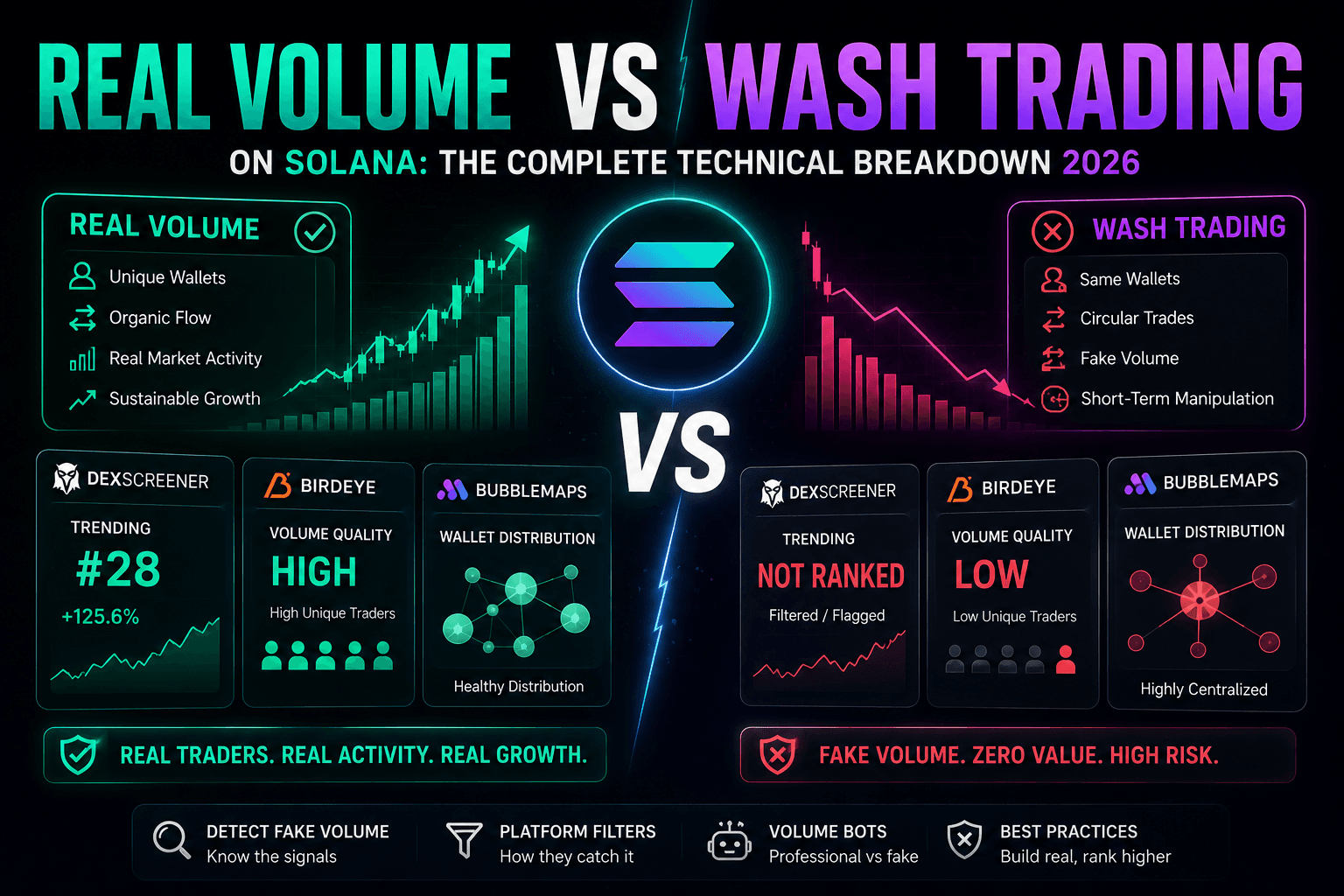
Real Volume vs Wash Trading Solana
June 6, 2026
In 2026, the most consequential question any Solana token founder or trader can ask about a token's chart is not "how much volume does it have?" — it's "is that volume real?" The distinction between genuine trading activity and wash trading determines everything: whether platform algorithms reward or penalize the token, whether real traders convert from discovery to buying, and whether a project builds lasting credibility or destroys it on its first day.
This guide is the definitive technical breakdown of real volume versus wash trading on Solana — covering the exact on-chain mechanics that separate them, how DexScreener, Birdeye, Dextools, and Bubblemaps each detect artificial volume, why wash trading fails completely for trending goals in 2026's algorithm environment, and how professional volume generation differs technically and structurally from wash trading. Every section answers a specific question being asked by founders, traders, and developers in the current market.
Quick Navigation — Jump Directly to Your Question:
1,700+
Projects Boosted with Real Volume
20M+
SOL Volume Generated (Real)
0
Security Incidents (No Private Keys)
100%
On-Chain Verifiable on Solscan
Exact Technical Definitions: Real Volume vs Wash Trading
Before analyzing how platforms detect the difference, how algorithms respond to each, and what the practical consequences are, it's essential to establish precise technical definitions. The terms "real volume," "fake volume," "wash trading," and "artificial volume" are used interchangeably in casual Solana discourse but have distinct meanings that carry very different technical and regulatory implications.
What Is Real Trading Volume?
Real trading volume, in the strictest technical sense, is the aggregate USD value of swap transactions between genuinely independent economic parties — where each transaction represents a real transfer of asset ownership between participants who have different economic motivations for the trade. The word "independent" is critical: the buyer and seller must not be the same entity or coordinated entities acting as a single economic unit.
Technical Properties of Real Volume
- Independence: buyer and seller are unrelated parties with no coordination
- Real price discovery: transaction price reflects genuine supply/demand
- Genuine transfer: ownership actually changes between independent wallets
- Economic motivation: each party acts on their own assessment of value
- Natural patterns: irregular timing, varied trade sizes, diverse wallets
- Real price impact: buying pressure moves price upward measurably
- Independent funding: trading wallets funded from diverse sources
- Verifiable on-chain: traceable to unique addresses with distinct histories
What Is Wash Trading?
Wash trading is a market manipulation technique where a single entity — or a group of coordinated entities acting as one — simultaneously or alternately buys and sells the same asset to create the appearance of trading activity. The key characteristic is that no genuine change of ownership occurs: the asset starts and ends with the same controlling party, but a volume number has been recorded that falsely implies independent demand.
In traditional finance, wash trading is explicitly illegal under the U.S. Commodity Exchange Act, the Securities Exchange Act, and equivalent legislation in most major jurisdictions. Its purpose is deceptive: to mislead other market participants into believing a security or asset is more actively traded than it actually is, typically to inflate price or attract genuine buyers who can later be sold to.
Technical Properties of Wash Trading
- Same controller: one entity controls both buy and sell wallet
- No real ownership change: asset returns to originating entity
- Manufactured price signals: price movement is engineered, not discovered
- Deceptive intent: purpose is to mislead other market participants
- Pattern regularity: mechanical timing and size create detectable signatures
- Low maker diversity: concentrated in 1–5 controlling wallets
- Common funding source: all wallets trace back to one origin wallet
- Minimal real price impact: engineered to cancel out buy/sell pressure
The Grey Zone: What Falls Between?
Between purely organic trading and pure wash trading lies a spectrum of activities that different platforms and jurisdictions classify differently. Understanding where each type falls is essential for any token team:
| Activity Type | Independent Wallets? | Real Price Discovery? | Platform Classification | Effectiveness for Trending |
|---|---|---|---|---|
| Organic trading | ✓ Always | ✓ Always | Real volume | Maximum |
| Professional multi-wallet volume bot (SolanaHolderBot) | ✓ Independent generated wallets | ✓ Real swaps via DEX aggregators | Real volume (passes all filters) | High — trending-optimized |
| Market making (LP provision) | ✓ Facilitates independent trades | ✓ Enables price discovery | Real volume | Moderate |
| Simple single-wallet bot (no randomization) | ⚠ 1 rotating wallet | ⚠ Partial | Flagged — reduced trending weight | Low — detectable patterns |
| Coordinated team trading (buy/sell between own wallets) | ✗ Same controller | ✗ Manufactured | Wash trading — suppressed | Minimal — flagged and penalized |
| Pure self-wash (one wallet, same token) | ✗ Identical wallet | ✗ None | Wash trading — heavily suppressed | Zero — immediately detected |
The Six Defining Technical Differences Between Real Volume and Wash Trading
The distinction between real volume and wash trading is not just philosophical — it is measurable, detectable, and algorithmically significant. Here are the six specific technical dimensions that separate them, with examples from real Solana on-chain data patterns:
Maker Count: The Fundamental Signal
Real volume produces a high ratio of unique wallet addresses (makers) relative to total volume. Organic trading on a trending Solana token generates hundreds of unique makers in a 24-hour window. Wash trading, regardless of total volume, produces extremely low maker counts — typically 2–10 unique wallets controlling the entire volume.
Real Volume Example
$500K volume / 24h → 340 unique makers
Ratio: 1 maker per ~$1,470 volume
Wash Trading Example
$500K volume / 24h → 4 unique makers
Ratio: 1 maker per ~$125,000 volume
Trade Timing Distribution
Organic human traders execute at random, unpredictable intervals driven by individual decisions — every few minutes, sometimes in bursts, sometimes with 20-minute gaps. Simple automated wash trading executes at mechanically regular intervals that no human could maintain: every 60 seconds, every 90 seconds, every 5 minutes exactly. This regularity is statistically impossible in organic trading and is one of the primary detection signals on every major analytics platform.
Real Volume Pattern
Trade intervals: 23s, 4m 12s, 1m 7s, 8m 44s, 31s, 2m 18s
Variance: High — natural human behavior
Wash Trading Pattern
Trade intervals: 60s, 60s, 60s, 61s, 60s, 60s
Variance: Near-zero — bot clock signature
Trade Size Distribution
Real traders execute trades based on their available capital, risk tolerance, and specific entry decisions — producing a wide, non-uniform distribution of trade sizes following a log-normal distribution (many small trades, fewer large trades, very few enormous trades). Wash trading often uses identical trade sizes or formula-derived sizes (e.g., exactly 0.5 SOL every cycle, or alternating 0.3 SOL / 0.7 SOL pairs) that create a recognizable mathematical signature.
Real Volume Size Distribution
0.03 SOL, 1.2 SOL, 0.15 SOL, 5 SOL, 0.08 SOL, 0.4 SOL
Natural variance — log-normal distribution
Wash Trading Size Pattern
0.5 SOL, 0.5 SOL, 0.5 SOL, 0.5 SOL, 0.5 SOL
Zero variance — mechanical repetition
Wallet Funding Graph
Every Solana wallet that executes a swap must have SOL in it to pay for transaction fees and the swap itself. In real organic trading, the funding sources of active wallets are diverse — some from CEX withdrawals, some from other DeFi protocols, some from peer transfers. In wash trading, all the active trading wallets were funded from a single source wallet in a visible cascade: the team wallet → wallet A → wallet B → wallet C, all in the same timeframe shortly before trading began. This tree structure is clearly visible on Solscan and is the first thing a sophisticated on-chain analyst checks.
Buy/Sell Ratio and Symmetry
Organic trading on a healthy token trending upward shows buy-heavy ratios (65–80% buys) driven by FOMO and discovery. Organic trading on a declining token shows sell-heavy ratios. Wash trading that attempts to neutralize price impact typically targets a 50:50 buy/sell ratio — which is statistically unusual for a genuinely trending token and creates a distinctive "dead volume" appearance. Conversely, wash trading that attempts to pump price may engineer 90%+ buy ratios that appear suspiciously one-sided with no corresponding organic sell pressure visible in wallet diversity.
Price Impact Reality vs Volume Claim
Real trading volume produces measurable price impact — large buys push price up; large sells push price down. The relationship between volume and price movement follows the pool's AMM math. Wash trading that alternates buys and sells engineered to offset each other produces near-zero price impact despite high claimed volume. A token claiming $2M in 24h volume with a 0.1% price change and only 3 unique makers has almost certainly been wash traded — real $2M volume on a typical Solana micro-cap pool would move the price significantly.
How Wash Trading Physically Works on Solana DEXes
Understanding the mechanical execution of wash trading is essential for both identifying it as a trader and understanding why it fails against modern platform detection. Here is the step-by-step execution of a typical naive Solana wash trading operation and its consequences:
Naive Wash Trading Flow (Why It Gets Detected)
- Setup: One team member creates 3–5 wallets from the same seed phrase or funds them all from the project's treasury wallet. The funding transaction graph is now a visible tree on Solscan.
- Execution: A simple script buys X SOL of the token from Wallet A, then sells the acquired tokens back to SOL from Wallet B, then repeats. Because it's scripted with a fixed interval (e.g., every 60 seconds), the timing signature is immediately detectable.
- Volume appearance: DexScreener shows growing volume numbers. The Makers column shows 3–5 unique addresses. The buy/sell ratio is approximately 50:50 (engineered to cancel out price impact).
- Platform detection: DexScreener's algorithm detects the pattern: low maker count + regular timing + symmetrical buy/sell ratio + common wallet funding source = reduced trending weight. The volume appears on the chart but contributes minimal score to the trending algorithm.
- Trader detection: Real traders who click through see 5 makers on a token claiming $200K volume. Solscan reveals all 5 wallets were funded from the same source 3 hours ago. The token is immediately classified as wash-traded and no organic buying occurs.
- Outcome: Money spent on SOL for transaction fees and any price impact loss, zero trending placement achieved, zero real buyer discovery, and potential lasting reputation damage for the project.
Attempted Wash Trading Sophistication (And Why It Still Fails)
Aware of basic detection, some operations attempt more sophisticated wash trading:
Attempt: More Wallets (20–50)
Creates more maker count. Why it fails: All 50 wallets funded from same source in same timeframe. Wallet funding graph analysis catches it. Timing patterns remain if underlying script isn't randomized.
Attempt: Randomize Trade Sizes
Varies trade sizes between 0.3–0.8 SOL. Why it fails: Range is too narrow to look organic. Distribution doesn't follow natural log-normal pattern. Timing still regular. Wallet funding still centralized.
Attempt: Mix Buying and Selling from Different CEX Withdrawal Wallets
Funds wallets from different CEX withdrawal addresses. Why it fails: CEX withdrawals in coordination show on-chain. Timing pattern between transactions still detectable. Still low holder count.
Attempt: Target Only the 24h Window
Run high volume for 24h to appear in one ranking. Why it fails: DexScreener trending requires multi-window consistency. Single-window spikes are a detection signal, not an asset. No holder count growth accompanies the volume.
The Fundamental Limitation of Wash Trading
Every form of wash trading shares one inescapable limitation: a small number of coordinated wallets cannot produce the statistical diversity of an unconstrained, random population of genuine traders. The gap between the statistical signature of real multi-party market activity and coordinated self-dealing is precisely what modern platform detection algorithms exploit. In 2026, those algorithms have become sophisticated enough to identify wash trading patterns that would have passed undetected in 2022–2023.
How Real Volume Is Generated: Organic Trading vs Professional Volume Tools
"Real volume" is not limited to the fully organic activity of independent retail traders who discovered a token on their own. Professionally generated volume using purpose-built tools is also real — when the technical structure of those transactions is genuinely independent, randomized, and passes platform detection without suppression. Understanding this distinction is crucial for founders evaluating their options.
Organic Volume Generation
The ideal outcome — real independent traders buying and selling based on genuine interest in the token's fundamentals, community, or meme potential. Completely unpredictable, highly variable, and impossible to guarantee or time. Every analytics platform treats this as maximum-weight volume.
Characteristics:
- Hundreds of fully independent wallet addresses
- Completely random timing and sizes
- Wallets with diverse on-chain histories
- Natural buy-heavy ratio during discovery phase
- Impossible to generate reliably on demand
Professional Multi-Aggregator Volume Generation
Purpose-built automated tools (like SolanaHolderBot) that generate genuine on-chain swap events from independent wallets with professional randomization, MEV protection, and multi-aggregator routing. The result passes platform detection because the transaction structure is identical to organic trading.
Characteristics:
- Up to 100 independent generated wallets
- True randomization of timing and trade sizes
- Professional buy/sell ratio (65–75% buy)
- Jito MEV protection on every transaction
- Multi-aggregator routing for maximum efficiency
What "Real on Solana" Actually Means at the Transaction Level
A transaction is "real" on Solana if it is a valid, confirmed, on-chain swap event that: (1) was signed by a genuine keypair, (2) executed against a real liquidity pool, (3) produced actual token transfers visible in wallet balances, and (4) was indexed by analytics platforms through their standard RPC event listeners. Professional volume bot transactions satisfy all four criteria — they are real swaps that move tokens and SOL between wallets, change on-chain balances, and appear identically to human-initiated swaps in every block explorer and analytics tool.
This is why the debate over whether professional volume tools are "real" or "fake" often confuses the economic purpose of the transactions with their technical nature. Technically, they are fully real. Economically, they are generated with strategic intent — but so is every trade made by a hedge fund, market maker, or algorithmic trader on any market in the world.
How DexScreener Detects and Penalizes Wash Trading in 2026
DexScreener is the most visited Solana token analytics platform and the one whose trending algorithm carries the most weight for token discovery. Its detection approach has evolved significantly from 2022's basic volume aggregation to 2026's multi-layer pattern analysis. Here is the complete breakdown of its current detection methodology:
Layer 1: Maker Diversity Score
DexScreener calculates a maker diversity score — the number of unique wallet addresses divided by total volume in a time window. Tokens with an anomalously low maker/volume ratio receive a suppression multiplier that reduces the trending weight of their volume. Thresholds are not public, but community analysis suggests tokens with fewer than 1 unique maker per $5,000–$10,000 in 24h volume consistently underperform in trending rankings regardless of total volume.
How professional bots pass: multi-wallet bots with 50–100 wallets produce maker counts that scale proportionally with volume, maintaining a high maker/volume ratio.
Layer 2: Temporal Pattern Analysis
DexScreener analyzes the standard deviation of inter-trade timing for a token's transaction history. Organic trading has high variance; bot trading without randomization has near-zero variance. When the standard deviation of trade intervals falls below a threshold relative to the mean interval, the volume weight is reduced. Tokens with mechanical 60-second intervals fail this check completely.
How professional bots pass: sophisticated timing randomization (15 seconds to 4+ minutes) produces high variance that matches organic trading distribution.
Layer 3: Trade Size Distribution Analysis
A natural trading population produces a right-skewed (log-normal) distribution of trade sizes — many small trades, fewer medium trades, few large trades. Wash trading produces either uniform distributions (all trades the same size) or multi-modal distributions (alternating between a few fixed sizes). DexScreener's statistical analysis of trade size distribution can flag non-organic patterns even when timing randomization has been applied.
How professional bots pass: true log-normal size randomization (e.g., 0.03–0.45 SOL with realistic skew) produces distributions statistically indistinguishable from organic trading.
Layer 4: Buy/Sell Ratio Plausibility
DexScreener evaluates whether a token's buy/sell ratio is consistent with its claimed price trajectory. A token showing 50:50 buy/sell ratio with near-zero price change but high volume is a strong wash trading signal — real trading with neutral ratios would produce price discovery (the balanced pressure still moves through the AMM and creates some price impact). A token with 95:100 buy ratio and zero price increase is also flagged as implausible.
How professional bots pass: organic-looking 65–75% buy ratio creates consistent upward price pressure, matching the expected trajectory for a new token in discovery phase.
Layer 5: Holder Count vs Volume Correlation
In 2026, DexScreener cross-references holder count with volume for trending eligibility. A token with $1M volume and 6 holders will not appear in main trending sections — the holder count to volume ratio is implausible for organic activity. This is the filter that pure volume-only wash trading or even basic volume bots without a holder component cannot pass.
How professional bots pass: running holder campaigns (SolanaHolderBot's Holder Bot or All-in-One Booster) simultaneously builds a plausible holder count that correlates correctly with volume levels.
Layer 6: Multi-Window Consistency Check
Wash trading operations often run for defined periods and then stop — creating sharp cliff patterns in time-window data: $500K in 24h but $0 in 6h and $0 in 1h. DexScreener's algorithm treats this as evidence of artificial volume generation (genuine organic trading never drops to zero instantly). Volume that is consistent across all four windows at proportional levels scores significantly higher.
How professional bots pass: Medium mode (3–6 hour campaigns) produces consistent activity across all windows simultaneously, with gradual natural tapering rather than cliff edges.
The Net Effect of DexScreener Detection
Wash trading does not cause a token to be removed from DexScreener — it simply gives that volume reduced weight in the trending algorithm. A token with $2M in wash-traded volume may end up with the effective trending contribution of a token with $50K in genuine volume. This is why wash trading produces no trending results despite significant SOL cost: the algorithm already discounts it before calculating the ranking score. Complete DexScreener trending algorithm guide →
How Birdeye Detects Artificial Volume
Birdeye takes a fundamentally different approach to volume quality assessment than DexScreener. While DexScreener focuses primarily on statistical pattern analysis of trading activity, Birdeye uses holder-centric metrics as its primary quality signal — which creates a different set of evasion challenges for wash trading operations.
Birdeye's Primary Quality Checks
- Holder growth rate velocity: The rate of new unique wallet addresses acquiring the token. Wash trading generates zero new holders (it's the same wallets trading back and forth). Without holder growth, a token cannot rank in Birdeye's "Rising" or trending sections regardless of volume.
- Holder retention rate: What percentage of acquiring wallets still hold the token after 24/48 hours. Wash trading wallets cycle — they buy then sell repeatedly, producing zero retention. Genuine holders retain.
- Volume-to-holder ratio: A token with $1M volume and 5 holders fails Birdeye's plausibility check. Real $1M tokens have hundreds of holders.
Why Wash Trading Can't Fake Birdeye Metrics
- Creating fake holders is separate from wash trading: You can't generate both simultaneously with wash trading alone. Wash trading creates volume; it doesn't create new permanent wallet addresses holding the token.
- Holder wallets cost real SOL: Each genuine holder wallet needs SOL for rent exemption and token accounts. Scaling fake holders is expensive if done correctly and detectable if done cheaply (dust wallets with no SOL get flagged by Birdeye).
- Timing correlation reveals coordination: If a wave of new "holders" appears exactly when a wash trading campaign starts, Birdeye's temporal correlation analysis identifies the coordination.
The result: wash trading produces zero benefit on Birdeye because the platform's primary ranking signal — holder growth rate — is immune to volume manipulation. The only approach that works on Birdeye is a legitimate holder creation campaign using rent-exempt wallets that hold tokens permanently. Complete Birdeye trending strategy guide →
How Dextools Identifies Wash Trading Patterns
Dextools' Hot Pairs algorithm has a structural property that makes it naturally resistant to basic wash trading: it primarily ranks by unique maker count, not by raw volume. This design decision was likely made precisely because volume is easier to artificially inflate than maker count.
Why Dextools Hot Pairs Naturally Resists Wash Trading
| Scenario | Volume (24h) | Unique Makers | Hot Pairs Score |
|---|---|---|---|
| Wash traded token | $2,000,000 | 5 unique wallets | Very Low — not in Hot Pairs |
| Professional multi-wallet campaign | $100,000 | 200 unique wallets | High — appears in Hot Pairs |
| Organic active token | $500,000 | 500+ unique wallets | Maximum — Hot Pairs top position |
The conclusion is stark: on Dextools, $2M of wash trading doesn't rank. $100K of legitimate multi-wallet volume does. Maker count is the only metric that matters.
For Dextools Hot Pairs specifically, the optimal approach is SolanaHolderBot's multi-wallet volume bot at t.me/sol_volume_multi_bot — which generates up to 100 independent unique makers simultaneously. Full Dextools strategy: Best Dextools Trending Bot 2026.
Bubblemaps: The On-Chain Wash Trading Detector That Traders Actually Use
Bubblemaps is a blockchain visualization tool that displays the ownership structure of a token by mapping wallet connections on-chain. It has become the default due-diligence tool for experienced Solana traders, used to instantly identify whether a token's holder distribution (and by extension, its trading volume) is genuine or coordinated.
What Bubblemaps Shows and How It Exposes Wash Trading
🔴 Wash-Traded Token on Bubblemaps
- A few massive bubbles (1–5 wallets controlling 60–90% of supply)
- Visible connection lines between trading wallets (all funded from same source)
- Team wallet clearly connected to all "trader" wallets
- No organic distribution pattern — extreme concentration with fake holder wallets visibly connected
- Transaction graph shows circular flow of tokens between connected wallets
Experienced traders see this pattern and immediately exit or avoid the token. Zero organic buying conversion results from this disclosure.
🟢 Legitimately Generated Volume on Bubblemaps
- Many small and medium bubbles (diverse distribution)
- No suspicious connection lines between trader wallets (independently generated)
- Holder wallets with varied SOL balances and token amounts (randomized)
- Clean cluster analysis with no single controlling entity visible
- Distribution pattern resembles what organic trading activity produces
Traders see a healthy distribution and treat it as a positive signal. Organic buying is not suppressed by Bubblemaps red flags.
How SolanaHolderBot's Architecture Produces Clean Bubblemaps
SolanaHolderBot's Holder Bot and All-in-One Booster are specifically engineered to produce clean Bubblemaps profiles because the Bubblemaps check is performed by sophisticated traders before making any significant buy decision. The architecture that achieves this:
Randomized token amounts per wallet: Each holder receives a different token amount (not uniform distribution), matching the natural variance of organic buying.
Varied SOL balances per holder wallet: Different amounts of SOL funded per wallet avoids the uniform-funding pattern that exposes coordinated creation.
Staggered deployment timing: Holders created in batches over time, not all simultaneously, avoiding the "100 wallets created in 3 minutes" clustering pattern.
Rent-exempt funding level: Each holder wallet has enough SOL to remain active indefinitely — avoiding the "zero SOL dust wallet" pattern Bubblemaps flags as fake holders.
No connection to main project wallet: The bot's funding mechanism doesn't create visible on-chain links between the project wallet and the generated holder wallets — a critical architectural feature that eliminates the cluster connection lines that expose wash trading.
Why Wash Trading Fails Completely for Trending Goals in 2026
Synthesizing everything covered so far, here is the complete picture of why wash trading — in all its forms — produces zero ROI for trending goals in 2026:
❌ Failure Point 1: DexScreener Algorithm Suppression
DexScreener's 2026 detection layers (maker diversity, temporal patterns, size distribution, buy/sell ratio plausibility, multi-window consistency) apply suppression multipliers to detected wash trading. The trending score contribution of suppressed volume is reduced by an estimated 70–90%, meaning $1M in wash trading might produce the trending contribution of $50K–$100K in legitimate volume. This makes wash trading dramatically cost-inefficient even before other failure points are considered.
❌ Failure Point 2: Holder Count Filter Cannot Be Bypassed by Volume Alone
DexScreener's main trending sections require minimum holder counts that wash trading cannot create. Wash trading generates volume but zero new holders. Without minimum holders, a token is algorithmically excluded from trending placement regardless of volume level. This single filter makes pure wash trading strategies completely ineffective for DexScreener main trending in 2026.
❌ Failure Point 3: Birdeye Immunity
Birdeye's primary ranking signal (holder growth rate) is completely immune to wash trading — you can wash trade $100M and generate zero new holders. Birdeye trending requires genuine holder creation, which is an entirely separate mechanism from volume generation. Wash trading on Birdeye has literally zero effect on trending rank.
❌ Failure Point 4: Dextools Natural Resistance
Dextools Hot Pairs ranks by unique maker count. A wash trading operation with 5 controlling wallets generates 5 unique makers regardless of how many transactions are executed. Appearing in Hot Pairs requires hundreds of unique makers, which wash trading with a small number of coordinated wallets cannot produce.
❌ Failure Point 5: Zero Organic Buyer Conversion
Even if wash trading temporarily achieves minimal trending visibility, real traders performing due diligence immediately identify it: low maker count on DexScreener, Bubblemaps clustering, Solscan wallet funding tree analysis. Identified wash trading converts zero organic buyers — the entire purpose of trending visibility is nullified. Real traders specifically avoid tokens with clear wash trading signatures due to the strong correlation with coordinated dump schemes.
❌ Failure Point 6: Reputation Destruction
Once identified as wash-traded, a token carries that designation in Solana community channels, Twitter/X threads, and Telegram groups. The reputation damage is essentially permanent for the token's contract address. Many due-diligence bots and Telegram alpha groups automatically flag tokens with wash trading signatures, ensuring that the information propagates to every potential investor community the project tries to reach.
Are Volume Bots Wash Trading? The Complete Technical Answer
This is the most frequently asked question by founders evaluating volume generation options and by traders trying to understand whether a token they're researching used legitimate tools or deceptive ones. The answer is nuanced and depends entirely on the technical architecture of the specific volume bot in question.
The Definitive Answer: Professional Volume Bots Are NOT Wash Trading
Professional volume bots like SolanaHolderBot are not wash trading because they do not share the defining characteristic of wash trading: a single entity controlling both sides of a transaction. Here is the exact technical comparison:
| Technical Criterion | Wash Trading | SolanaHolderBot | Organic Trading |
|---|---|---|---|
| Wallet controller | Same entity controls all wallets | Independent generated wallets; no shared controller | Completely independent individuals |
| Unique maker count | 2–10 wallets maximum | Up to 100 unique wallet addresses | Hundreds to thousands |
| Trade timing | Regular mechanical intervals | Truly randomized (15s–4+ min) | Completely random |
| Trade size distribution | Uniform or formulaic | Log-normal randomization (organic distribution) | Natural log-normal |
| Real price discovery | Engineered to minimize price impact | Real buy pressure creates genuine price movement | Natural price discovery |
| MEV extractability | Can be sandwiched (proves it's real exposure) | Jito-protected; demonstrates real market exposure | Variable protection |
| DexScreener classification | Suppressed — reduced trending weight | Full trending weight — passes all filters | Full trending weight |
| Bubblemaps appearance | Clustered, connected wallets visible | Clean distributed profile (random wallet creation) | Clean distributed |
| Ownership change | No real change (same entity) | Real token transfers between independent wallets | Real ownership transfer |
| Aggregator routing | Direct pool access (no aggregator) | Jupiter + DFLOW + OKX+ real public aggregators | Via any aggregator |
The distinction matters because it determines every downstream outcome: platform detection results, Bubblemaps appearance, trader due diligence results, and ultimately whether the investment achieves its goal of generating real organic discovery. A professional volume bot produces real transactions that look real because they are real — they are just generated strategically rather than randomly.
For a direct comparison between different service types: Solana Volume Bot Compared 2026 | SolanaHolderBot vs Fatality Bot – Full Technical Comparison
What Makes Professional Volume Look Real: The Four Core Technologies
The gap between volume that passes platform detection and volume that gets suppressed comes down to four specific technical capabilities. Each of these is a significant engineering investment — which is why the difference in outcomes between a professional service and a free GitHub script is so dramatic.
🔀 Technology 1: True Statistical Randomization
Not just "different numbers" but statistically correct distributions. Trade sizes follow a log-normal distribution (matching real trader behavior). Time intervals follow an exponential distribution with appropriate parameters. Buy/sell ratios are set at organic-looking 65–75% buy. Without genuine statistical modeling, "randomization" is just a uniform distribution that still looks mechanical to pattern detection algorithms.
🌐 Technology 2: Multi-Aggregator Routing
Real organic traders use Jupiter, DFLOW, or whichever aggregator gives the best price. Professional bots query multiple aggregators simultaneously and route to the cheapest path — exactly as a real trader with a price-sensitive order would. Single-route bots that always use Jupiter exclusively create a routing pattern that differs from organic trading diversity. Multi-aggregator routing also produces 30–50% more volume per SOL, making it both a detection-avoidance and efficiency technology.
🛡️ Technology 3: Jito MEV Bundle Protection
This is a counterintuitive detection-avoidance mechanism: by protecting transactions from MEV attacks, the bot demonstrates that its transactions have real economic exposure. Wash trading is inherently MEV-resistant because the wash trader controls both sides — there's nothing for an MEV bot to extract. Jito-protected legitimate volume bots operate more like genuine independent traders, since they face (and are protected from) the same sandwich attack environment.
👥 Technology 4: Independent Wallet Architecture
The most fundamental technology: every trading wallet is freshly generated with an independent keypair, not linked to any other wallet in the campaign through funding chains. This ensures that on-chain graph analysis (the same analysis Bubblemaps performs) shows no coordinating structure. Each wallet appears as an independent actor — which it is, in the sense that no single controller can be identified from on-chain data analysis alone.
How to Identify Wash Trading on a Solana Token: A Complete Checklist for Traders
For traders and investors evaluating Solana tokens, identifying wash trading before committing capital is a critical due diligence skill. Here is the complete five-tool checklist that experienced Solana traders use — each check takes under 2 minutes and the combination is highly reliable:
DexScreener Makers Column Check
On DexScreener, navigate to any token pair and look at the Makers column in the trading data section. This shows the number of unique wallet addresses that have traded the pair in each time window.
100+ makers
Healthy — consistent with claimed volume
10–50 makers
Investigate further — may be early launch
Under 10 makers
Strong wash trading signal — very high risk
Birdeye Holder-to-Volume Ratio
Open the token on Birdeye and compare the holder count to the 24h volume. Apply this rule of thumb: genuine tokens have at minimum 1 holder per $5,000–$15,000 in 24h volume during active trading. Tokens showing $500K volume with 15 holders have an implausible ratio — strong wash trading indicator.
Also check: Birdeye's holder chart — does holder count grow over time, or is it static despite claimed volume? Wash traded tokens show flat holder counts with high volume numbers.
Solscan Transaction History Review
Go to Solscan, search the token's contract address, and click on the "Transfers" tab. Look at the wallet addresses appearing in buy transactions — click on 2–3 of them and trace their SOL funding history. If they were all funded from the same wallet address on the same day shortly before trading began, the wash trading structure is confirmed.
Also check trade timing: select 10 consecutive transactions and compare their timestamps. Regular intervals (every 60, 90, 120 seconds) are mechanical bot signatures. Irregular intervals are organic or professional bot signals.
Bubblemaps Clustering Analysis
Navigate to bubblemaps.io and search the token's contract address. A healthy token distribution shows many bubbles of varied sizes with minimal connection lines. Wash-traded tokens show: large connected bubble clusters with visible lines between trading wallets, extreme concentration (top 5 wallets controlling 70%+ of supply), and obvious connection between deployer wallet and all "trader" wallets.
Key metric: If the top 10 holders control more than 80% of supply and are visibly interconnected, the token is almost certainly wash-traded and/or team-controlled with coordinated trading.
Price Impact Plausibility Test
Check the token's price chart against its volume chart. For a typical micro-cap Solana token (under $500K market cap) with a standard 0.25–0.3% fee pool, genuine $50K+ in volume should produce measurable price movement — typically 20–50%+ price change in a day with that volume level. If a token claims $500K in 24h volume but shows a flat price line or less than 5% price change, the volume is not producing real price discovery. This is a strong wash trading indicator.
Quick Reference: Wash Trading Red Flags Summary
- Under 10 unique makers with $100K+ volume
- All trading wallets funded from same source
- Mechanical regular trade intervals (60s, 90s, 120s)
- Identical or obviously formulaic trade sizes
- Exactly 50:50 buy/sell ratio with no price movement
- High volume + flat price line (no price discovery)
- High volume + static holder count (no organic buying)
- Bubblemaps shows connected trading wallet cluster
- Top 5 wallets control 80%+ of supply
- Volume drops to zero immediately after a fixed period
The Legal and Reputational Risk Landscape for Wash Trading on Solana
The question "is wash trading illegal in crypto/Solana DeFi?" is more complex than a simple yes or no, and the answer has been evolving rapidly as regulators worldwide have increased focus on the crypto asset market.
The Regulatory Landscape by Jurisdiction
| Jurisdiction | Regulatory Stance on Wash Trading | Enforcement Focus |
|---|---|---|
| United States | Illegal on regulated exchanges (CEA, Securities Exchange Act). Application to DeFi DEXes remains unsettled but CFTC has claimed jurisdiction over DeFi in multiple cases. Securities-classified tokens carry the highest risk. | Primarily focused on fraud-linked wash trading (inflate-and-dump schemes) and CEX-based manipulation |
| European Union | MiCA (Markets in Crypto-Assets Regulation) explicitly prohibits wash trading in crypto markets. EU-based projects face clear legal exposure. | MiCA enforcement beginning 2026; exchange-level compliance being implemented |
| United Kingdom | FCA has classified wash trading in crypto as market manipulation. UK-based projects or teams face regulatory exposure under UK financial law. | Primarily enforcement against coordinated pump-and-dump schemes |
| Permissionless DeFi | No platform-level legal enforcement; algorithmic suppression is the primary consequence. Legal exposure still exists for identifiable individuals who use wash trading as part of securities fraud schemes. | Platform-level suppression replaces legal enforcement; individuals remain exposed |
The Reputational Risk: Why It's Often Worse Than Legal Risk
For most Solana token projects, reputational risk from identified wash trading exceeds legal risk in practical terms. The Solana community has developed sophisticated on-chain analysis capabilities, and identified wash trading is communicated across alpha groups, CT (Crypto Twitter/X), and Telegram communities within minutes of detection. The consequences:
Instant KOL (Key Opinion Leader) avoidance: Major Solana alpha accounts with large followings actively avoid calling tokens identified as wash-traded, cutting off the primary organic amplification channel for new tokens.
Due diligence bot flagging: Multiple popular Telegram due diligence bots (used by traders to quickly vet tokens) automatically flag tokens with wash trading signatures, ensuring the information reaches every community the project enters.
Permanent contract address stigma: Unlike traditional companies that can rebrand, a Solana token's contract address is immutable. A wash-traded CA carries its history forever — subsequent legitimate campaigns cannot erase the on-chain evidence.
Team identity exposure: Wallet funding analysis can trace wash trading wallets back to team wallets used in previous projects — damaging a team's reputation across all future launches, not just the current one.
Disclaimer: This section is provided for educational purposes and does not constitute legal advice. Regulatory positions on DeFi wash trading are actively evolving. Project teams should consult qualified legal counsel for jurisdiction-specific guidance.
Is Wash Trading Worth It? Cold ROI Numbers vs Professional Volume Generation
Setting aside legal and reputational considerations, let's evaluate wash trading purely on economic terms — what does it cost, what does it produce, and how does that compare to professional volume generation?
| Metric | Naive Wash Trading (5 wallets) | Sophisticated Wash Trading (50 wallets) | SolanaHolderBot (Multi-Wallet) |
|---|---|---|---|
| SOL cost per $100K volume | ~0.3 SOL (tx fees) + price impact loss | ~0.5 SOL + price impact loss | ~0.5–1 SOL (efficient routing) |
| DexScreener trending weight | ~10% of nominal (suppressed) | ~30–40% of nominal (partially suppressed) | ~100% (full weight, passes all filters) |
| Unique makers produced | 5 unique wallets | 50 unique wallets (but obviously coordinated) | Up to 100 (independently generated) |
| DexScreener holder filter | ❌ Fails (no new holders) | ❌ Fails (no new holders) | ✓ Passes when combined with Holder Bot |
| Birdeye trending contribution | Zero — holder growth is immune | Zero — holder growth is immune | High — Holder Bot creates genuine growth rate |
| Dextools Hot Pairs contribution | Minimal (5 makers = not in Hot Pairs) | Partial (50 makers may appear) | High (100 independent makers) |
| Bubblemaps safety | ❌ Obvious clustering detected | ⚠ Partially detected | ✓ Clean distributed profile |
| Organic buyer conversion rate | ~0% (immediately identified) | ~5–15% (partially convincing) | High — full trending visibility converts |
| Security risk | Reputational + potential legal exposure | Reputational + potential legal exposure | None — no private keys, verified service |
| MEV loss | Low (coordinated, harder to sandwich) | Low-moderate | Zero (Jito bundle protection) |
| Overall ROI for trending goals | NEGATIVE — money lost, zero results | POOR — partial results, high risk | POSITIVE — full trending visibility achieved |
The economic conclusion is unambiguous: wash trading produces negative ROI for trending goals because platform suppression eliminates most of its nominal volume contribution, while it also fails all holder-based filters and produces zero organic buyer conversion. Professional multi-aggregator volume generation with proper pattern randomization costs similar SOL amounts but achieves full trending weight, passes all platform filters, and produces genuine organic discovery traffic.
Real Volume Strategy That Actually Works in 2026
With the complete technical picture established — wash trading fails, professional volume generation succeeds — here is the actionable strategy for generating real, effective, platform-passing volume for a Solana token launch in 2026:
The Four Official SolanaHolderBot Tools and When to Use Each
📈 Single Wallet Volume Bot
Highest volume per SOL efficiency. Best for: initial Pump.fun launch burst, bonding curve sprint, single-platform DexScreener targeting.
→ From 0.1 SOL | Fast/Medium/Slow modes
→ Jito MEV protection + multi-aggregator routing
t.me/leektradingbot →
⚡ Multi-Wallet Volume Bot (100 Wallets)
Maximum unique maker count. Best for: Dextools Hot Pairs, DexScreener maker diversity filter, cross-platform trending requiring high maker count signals.
→ From 0.1 SOL | Up to 100 simultaneous wallets
→ Most organic-looking — highest unique maker output
t.me/sol_volume_multi_bot →
💎 Holder Bot (Permanent Holders)
Permanent rent-exempt holders. Best for: Birdeye trending, DexScreener holder count filter, Bubblemaps clean profile, investor credibility building.
→ From 0.1 SOL | 10–500 permanent holders
→ Rent-exempt wallets — holders stay forever on-chain
t.me/Degen_wg_bot →
🚀 All-in-One Booster
Volume + holders simultaneously. Best for: complete launch campaigns, maximum cross-platform impact, when budget allows only one tool choice.
→ From 0.15 SOL | Volume + holders in one campaign
→ Most cost-efficient for complete launch sequences
t.me/sol_volume_holder_bot →
Complete Platform-Targeting Strategy: What to Run, When, and How Much
| Target Platform | Primary Bot | Mode | Budget | Key Signal Produced |
|---|---|---|---|---|
| Pump.fun launch ignition | All-in-One | Fast | 0.2–0.5 SOL | Volume + holders simultaneously from minute 1 |
| DexScreener New Pairs | Single wallet | Medium (6h) | 0.5–2 SOL | Multi-window volume consistency |
| DexScreener Trending (main) | All-in-One + multi-wallet | Medium | 2–5 SOL | Volume + holders + maker diversity |
| Birdeye Rising | Holder Bot (waves) | 3× batches | 0.3–1 SOL holders | Holder growth rate acceleration |
| Dextools Hot Pairs | Multi-wallet only | Medium (4–6h) | 0.5–2 SOL | 100 unique makers (Hot Pairs primary signal) |
| Full cross-platform Top 10 | All-in-One + multi-wallet | Parallel | 5–15 SOL | All signals simultaneously across all platforms |
For the complete cross-platform strategy guide covering every combination and timing sequence: Best DEX Rank Bot 2026. For the complete volume bot technical overview: Crypto Volume Bot – Complete Technical Guide.
Complete FAQ: Real Volume vs Wash Trading — Every Question Answered
What percentage of Solana DEX volume is fake or wash traded?
Independent on-chain analysis of the broader crypto market consistently finds that a large portion of reported volume on smaller venues and newer tokens shows wash trading characteristics. Some academic studies estimate 40–80% of reported crypto exchange volume industry-wide may be artificial. On Solana specifically, the situation varies dramatically by token — established tokens (SOL, top DeFi protocols) have predominantly genuine volume, while new micro-cap tokens frequently show wash trading patterns in their early days. DexScreener's detection filters have significantly reduced the impact of wash trading by suppressing it in trending scores, even if they can't eliminate it from the raw volume charts.
Can DexScreener ban a token for wash trading?
DexScreener doesn't "ban" tokens in the traditional sense — it doesn't remove tokens or pairs from its database. Instead, it applies algorithmic suppression: tokens with detected wash trading patterns have their trending algorithm weight reduced, meaning they receive less beneficial treatment from the trending algorithm regardless of nominal volume. The token and its trading history remain visible on DexScreener indefinitely. This approach means wash trading has zero benefit for trending placement but doesn't create a permanent platform block — however, the on-chain evidence of wash trading persists on Solscan and Bubblemaps forever, affecting real trader due diligence independently of DexScreener's approach.
How do wash trading and market making differ on Solana DEXes?
Market making on a Solana DEX involves depositing token and SOL into a liquidity pool (e.g., Raydium CPMM pool) and earning fees from the two-sided activity of independent traders who swap against your liquidity. You're not trading with yourself — independent buyers and sellers interact with your deposited liquidity. Wash trading involves directly buying and selling the same token using wallets you control, with no independent third-party interaction. The practical test: does a real independent person trade against your activity? Market making — yes. Wash trading — no. Professional volume bots fall in a middle category: they generate real on-chain swaps from independent wallets but with a strategic purpose, making them structurally more similar to market making than to wash trading.
Does wash trading affect a token's price on Solana?
It depends on how the wash trading is executed. Perfectly balanced wash trading (equal buys and sells through the AMM) does produce small net price impact because AMM math (constant product formula: x × y = k) means that each individual buy and sell has slightly different price impacts at different liquidity depths — the net effect is usually a slight upward drift. Imperfectly balanced wash trading (buy-heavy) will push price up, which can attract some momentum buyers before the wash trader sells. However, the price impact from wash trading is generally less than equivalent genuine organic buying pressure because the AMM sees the round-trip effect of both sides of each wash cycle.
What is "artificial volume" in crypto and how is it different from fake volume?
"Artificial volume" and "fake volume" are often used interchangeably but have a subtle distinction. Fake volume typically refers to non-existent trades — reported volume numbers that have no corresponding on-chain transactions (this occurs primarily on centralized exchanges that have been caught fabricating data, not on Solana DEXes where all activity is publicly verifiable). Artificial volume refers to real on-chain transactions generated for strategic purposes rather than organic trading intent. On Solana, all volume is verifiable on-chain, so "fake" in the traditional sense doesn't apply — but "artificial" volume from wash trading or professional volume bots is real at the transaction level while being generated strategically rather than organically. The key distinction for platform detection is not whether volume is "artificial" but whether it passes statistical detection for genuine multi-party independent trading activity.
Which is better for a new Solana meme coin — a volume bot or trying to attract organic volume first?
The honest answer: organic volume almost never happens first on a new token without strategic support. The cold start problem is real — analytics platforms only surface tokens that are already active, and organic traders only discover tokens that appear on analytics platforms. Professional volume generation solves this by creating the initial activity that makes a token visible, which then attracts real organic buyers who then generate additional genuine volume. The strategic sequence is: professional volume + holder generation campaign → trending placement → organic discovery traffic → real organic trading volume. Starting with zero volume and waiting for organic activity produces nothing in the competitive 2026 Solana launch environment, where hundreds of tokens launch per day.
How long does generated volume stay on DexScreener?
Volume stays on DexScreener forever in the historical chart data — the on-chain transactions are permanent and DexScreener's index is permanent. For trending purposes, the relevant windows are rolling: 5-minute, 1-hour, 6-hour, and 24-hour. Once a campaign ends, the volume generated rolls out of each window over time — the 5-minute window clears in 5 minutes, the 24-hour window clears in 24 hours. To maintain trending, campaigns need to maintain volume within the relevant windows. This is why Medium mode (3–6 hour campaigns) is optimal for DexScreener — it populates the critical 6-hour window continuously while the campaign runs, and the organic traffic attracted during that window converts to additional genuine volume that extends the token's visibility organically.
Can I use a volume bot on a Token2022 Solana token?
Yes — SolanaHolderBot fully supports both SPL token standard and Token2022. Token2022 tokens have different transfer instruction formats that simpler bots often don't support, leading to failed transactions. SolanaHolderBot includes gasless Token2022 execution — the bot handles the Token2022-specific transfer mechanics automatically, including transfer fee calculation if your token has transfer fees enabled. Always verify Token2022 compatibility explicitly with any service before running a campaign; not all volume bot services support the full Token2022 feature set.
What happens to the SOL spent in a professional volume bot campaign?
In a professional multi-aggregator volume campaign, the SOL primarily circulates: buys push it into the liquidity pool (acquiring tokens), sells return it from the pool (selling tokens back). The SOL consumed in the process is: DEX swap fees (typically 0.25–0.30% per swap), Solana transaction fees (~0.000005 SOL per transaction, negligible), and Jito MEV protection tip (minimal). The rest is the volume generation effect — with 0.25% fee pools and 200 round-trip swaps, you generate approximately 100× the input SOL in on-chain volume (0.5 SOL → 50 SOL of visible volume). Unused SOL remaining in the bot's wallets can always be withdrawn instantly via a Telegram command.
What is the fastest way to get a Solana token on DexScreener trending without wash trading?
The fastest legitimate path in 2026: (1) Create 50–100 permanent holders first using SolanaHolderBot's Holder Bot at t.me/Degen_wg_bot — this crosses DexScreener's holder filter gate. (2) Immediately launch an All-in-One campaign at t.me/sol_volume_holder_bot with 1–2 SOL on Medium mode — this populates all four DexScreener time windows with legitimate, randomized, multi-aggregator volume. (3) If targeting Dextools simultaneously, add a multi-wallet campaign at t.me/sol_volume_multi_bot for maximum maker count. With correct timing (peak UTC hours) and 2–3 SOL total budget, DexScreener trending entry is consistently achievable within 2–4 hours of campaign start.
Do Solana analytics platforms share wash trading detection data with each other?
No — DexScreener, Birdeye, Dextools, GeckoTerminal, and other analytics platforms operate independently and do not share detection data with each other. Each platform uses its own proprietary algorithm and applies its own suppression independently. This means it's theoretically possible for a token to pass one platform's detection while being suppressed on another — though professional volume generation that passes DexScreener's sophisticated detection (the most advanced) will typically also pass less sophisticated detection systems on other platforms. The permanent on-chain record on Solscan and the visual Bubblemaps analysis are the common reference points that exist independently of any platform's internal detection.
Generate Real Volume That Passes Every Platform — From 0.1 SOL
Professional multi-aggregator routing. Jito MEV protection. 100-wallet maker diversity. Clean Bubblemaps. No private keys. 24/7 support.
Full documentation and overview: solanaholderbot.com | GitBook: solana-holder-bot.gitbook.io
Complete Solana Volume Cluster — Related Guides
Every guide in the Solana Volume strategy library — covering all platforms, use cases, and technical questions:
How Solana Trading Volume Is Calculated
On-chain mechanics, time windows, DexScreener/Birdeye/Dextools algorithms
Best Solana Volume Bots 2026 – Complete Guide
All 4 bot types, success rates, pricing, security analysis
Solana Trading Volume Bot Guide 2026
Step-by-step setup guide for every bot type
Solana Volume Bot Compared 2026
Single vs multi-wallet, all platforms head-to-head
Crypto Volume Bot – Complete Technical Guide
How volume bots work — all 4 bot types in depth
Best DexScreener Trending Bot 2026
Multi-window algorithm, filter bypass strategy
Birdeye Trending 2026 – Holder Strategy
Holder growth rate algorithm, wave deployment
Best Dextools Trending Bot 2026
Hot Pairs algorithm, unique maker count maximization
Best DEX Rank Bot 2026 – Cross-Platform
Complete cross-platform ranking strategy
Best PumpFun Volume Bot 2026
Bonding curve strategy, speed modes, migration continuity
Best Pump.fun Holder Bot 2026
Permanent holders, rent-exempt mechanics, packages
Best Solana Volume Booster 2026
Complete volume booster ecosystem overview
Cheapest Raydium Volume Bot 2026
Zero platform fee Raydium campaigns
Solana All-in-One Booster Bot 2026
Volume + holders combined, simultaneous campaigns
Best Bot for Pump.fun Marketing 2026
Complete Pump.fun marketing playbook
SolanaHolderBot vs Fatality Bot – Full Comparison
7-category head-to-head, security analysis, final scores